
An AI-dreamfished guide to understanding Kristang identity, creolisation, and colonial naming practices and history. See also the page on Assimilating into Kristang.
0. Why does the 13th Kabesa of the Kristang people have a Chinese surname?
Because surnames do not determine Kristang identity, Kristang leadership eligibility, or the legitimacy of a Kabesa.
The 13th Kabesa has a Chinese surname simply because his mother is Kristang and his father is Chinese — and this has no impact whatsoever on his Kristang identity, his lineage position, his legitimacy, or the continuity of the Kabesa role. Kristang identity is creole, not patrilineal, not surname-dependent, and not race-classified.
Those are British colonial bureaucratic rules, not Kristang cultural ones.
The 12 Kabesa preceding Kevin have Portuguese, Malay, Indian, Dutch, British, Sinhalese, Macanese, French, German, and multiple instantiations of unknown slave, concubine and orphan or adoptee ancestry and relation. A Chinese surname is therefore fully within historical norm, not an anomaly.
That is the complete, direct, technical answer.
Everything below explains the historical context for people who need it.
1. Is it unusual for a Kristang person to have a Chinese surname (or a Malay or Indian patronymic, or any other “non-European” name)?
No. It is entirely normal and historically consistent.
Kristang identity (not Eurasian identity; Eurasian identity is different and larger than Kristang, and is explained in other points below) is not tied to having a European-origin surname. Surnames in Kristang society have shifted for centuries due to intermarriage, assimilation, mobility, adoption, orphanhood, political conditions, and survival strategies in port-city environments.
The idea that Kristang people must have European-origin names is a colonial-era rule used to categorise people that has become misconception, not a Kristang cultural rule.
2. Didn’t some institutions in Malaya once require “European-sounding” names for Eurasian identity?
Yes — but that was a British colonial administrative decision, not a Kristang one.
In Singapore, before March 1994, these institutions simply inherited the British classification system, which defined “Eurasian” patrilineally by requiring an etymologically European surname for official recognition. This system excluded:
- Children of Portuguese-Eurasian, Dutch-Eurasian and British-Eurasian mothers with Chinese/Malay/Indian/non-European fathers
- Families who culturally lived as Kristang or who had adopted or assimilated into Kristang
This was bureaucracy, not culture.
Kristang people never really organised themselves this way, and the Kabesa lineage certainly did not.
3. So how did Kristang people historically determine identity?
Research by a significant number of scholars, including Margaret Sarkissian, Brian Juan O’Neill, Radin Fernando, Teddy Sim, Dennis De Witt, Willy Vande Walle, Maria De Jesus Espada and Kevin himself, shows that Kristang communities
- Identified and continue to identify or perform identity differently in different contexts
- Absorbed outsiders who lived according to and assimilated into Kristang norms
- Made pragmatic identity choices for trade, schooling, safety, mobility, and religion
- Prioritised community membership, neighbourhood networks, and language, not surnames or blood quantum
In short: Kristang identity was flexible, situational, and deeply creole.
For example, in his 2004 chapter “The Metamorphosis of the Luso-Asian diaspora in the Malay Achipelago, 1640-1795” in the academic book Iberians in the Singapore-Melaka Area (16th to. 18th Century), Dr Fernando provides, as an illuminating example, a Kristang trader in Melaka, Joseph de Andrade, who is said to have at first been
…referred to as a Portuguese (on his outgoing entry on 18 March 1697), a burgher on his next appearance in the records (incoming entry on 17 January 1707), then as a black (between 1714 and 1715) and finally as a maardijker (1719). A few years later Joseph de Andrade appeared as a black or native burgher.
p. 10
Dr Fernando also explicitly further states that “there are many more instances like this in the harbour-master’s records” (p. 10).
One could even argue — as some of the scholars above actually come close to doing — that the ability to move between multiple, sometimes even contradicting identities is paradoxically one of the most defining features of Kristang identity.
4. Does the Kabesa lineage reflect this historical openness?
Yes — the lineage of the very first Kabesa, Adriaan Koek (1759-1825, Kabesa from 1795-1824), is one of the strongest historical examples of Kristang creolisation, assimilation, and openness to outsiders.
The ancestry of Maria Dionicia Wilhelmina Dieterich, Adriaan’s wife and the great-great-great-great-great-great-grandmother of the current 13th Kabesa, demonstrates that the earliest creole leadership in Malacca was already profoundly multi-ethnic, multi-status, and creolised.
The Dieterich–Koek line: a microcosm of Kristang identity
As described by professor emeritus Willy Vander Walle in his 2012 book chapter “Malacca under Dutch Rule (1641-1795 and 1818-1825)” in the academic book Port Cities and Intercultural Relations
15th-18th Centuries, prominent Burgher families in Dutch Malacca, some of whom bear now very recognisably Kristang surnames—Angelbeek, Dieterich, Koek, Kraal, Neubronner, Rappa, Velge, Westerhout and Wiederhold—intermarried extensively. Many also intermarried with locals, freed slaves, and “Portuguese” (occasionally in Dutch usage: Indo-Portuguese / Indian Christian / freed-slave) communities.
The Dieterich family is emblematic:
• Gustaaf Dieterich (Dirksen) (died 1779)
A German who assimilated into the Dutch community, serving as VOC accountant, senior clerk of policy, secretary of justice, and deacon (1755–1760). He married across ethnic and status lines, showing exactly how creole identities formed:
- Wife #1: Johanna Maria de Roth (1735-1760), baptised “ex matre Famula van Mandaro,” meaning
– her mother was a freed slave with only a first name
– “from Mandaro” indicates Indian origin
– categorised as “Portuguese” in Dutch records (i.e., Indo-Portuguese Christian). - Wife #2: Kittjil van Makassar / Catharina Wilhelmina (ca 1741-1837), originally a Makassarese slave, later freed and baptised.
- Partner: Christina Rebello, another freed slave with a “Portuguese” name, likely of Indian descent, with whom he had a son he acknowledged and integrated fully into the Dieterich line.
Thus the Dieterich household contained German, Dutch, Makassarese and freed-slave ancestry simultaneously — and all of them were integrated into the “European” community in Malacca by baptism, marriage, and assimilation.
• Their daughter: Maria Dionicia Wilhelmina Dieterich (1769-1818)
Baptised by a Roman Catholic priest and later admitted to the Dutch Reformed Church, reflecting the fluid religious and ethnic boundaries of the era.
• Her husband: Adriaan Koek (1st Kabesa), and great-grandfather of one of the most influential Eurasian people ever in Malaya, Edwin Tessensohn (4th Kabesa)
Son of Joost Koek (1731-1790) and Catharina de Roth (c. 1735-1769), whose own mother was a freed slave of Sinhalese origin.
In addition to being Kabesa from 1795 to 1824, Adriaan was:
- Tuan Raja Muda and Secunde (Deputy Governor) of Malacca (1819–1824)
- President of the Council of Justice
- key figure in early Malay–Dutch lexicography
- trusted intermediary of the Malay rulers of Riau–Johor
He and Maria Dionicia had nine children, forming one of the most influential creole lines in Malacca.
What this means for Kristang identity
Recalling the 3rd Kabesa, Eliza Tessensohn (1833-1927, Kabesa from 1856 to 1874), whom he knew as Nanny, and her son the 4th Kabesa, Edwin Tessensohn (1855-1926, Kabesa from 1874 to 1926), whom he knew as Grandpa Edwin, in a 2002 Oral History Centre of Singapore interview, former Tessensohn family friend Winston Arthur Reginald Mathews recalls that Eliza not only spoke Kristang primarily — she was actually brought up that way:
Interviewer [Denyse Tessensohn, DT]: Did nanny speak to you in English, Malay or Kristang?
Reel 1 of 7 transcript p. 11 (= timestamp approx. 23:02-23:18)
Winston Mathews [WM]: I think she could understand a little bit of English and a little bit of Malay. And she spoke Kristang I think, because she was brought up that way.
Eliza’s parents were Jacobina Koek (1797-1868) and Jan (or John) Tessensohn (1808-1852). Since Jacobina was one of the daughters of Adriaan Koek (making Eliza Adriaan’s granddaughter), Eliza being “brought up speaking Kristang” can only mean that Jan and Jacobina’s household itself, and Jacobina herself, were already a Kristang-speaking, Kristang-performing domestic environment. In other words, Kristang was not something later adopted by the Koeks; it was one of their primary home languages from the very beginning. Because for Eliza to have been raised in Kristang, her mother and her mother’s parents in turn must have already been actively maintaining Kristang speech, forms of Kristang domestic culture, and Kristang relational identity.
The ancestry of the 1st Kabesa thus demonstrates:
- The earliest Kristang leadership already included non-European ancestry.
- Slave, freed-slave, Indian Christian, Makassarese, Dutch, German, and Malay lineages all merged naturally into Kristang identity.
- Ethnic assimilation, religious conversion, intermarriage, change of social or class status and adoption were relatively more common than one might imagine — not exceptions.
- Leadership legitimacy in Kristang civilisation was never based on racial purity, paternal descent, or surname. It was based on service, assimilation and respect for the community.
As Prof Emeritus Vander Walle goes on to write of Kevin’s great-great-great-great-great-great-great-grandfather Gustaaf Dieterich:
Gustaaf Dieterich was a representative case. He chose his bride from among the mestizo community, typically of a Dutch father, who had adopted her. His second wife was apparently a concubine of Malay stock, who was set free and baptised, and thus joined the fictitious European community. His case also shows the common practice of creating a marriage market that encompassed not only Malacca, but the entire East Indies.
p. 157
In short:
The 13th Kabesa having a Chinese surname is arguably less “mixed” than the documented ancestry of the 1st Kabesa himself, and therefore of the 3rd, 4th and 10th Kabesa as well, who are all descended from the 1st Kabesa (ancestry chart).
The Kabesa lineage has never been racially bounded — it has always been creole, adaptive, and integrative.
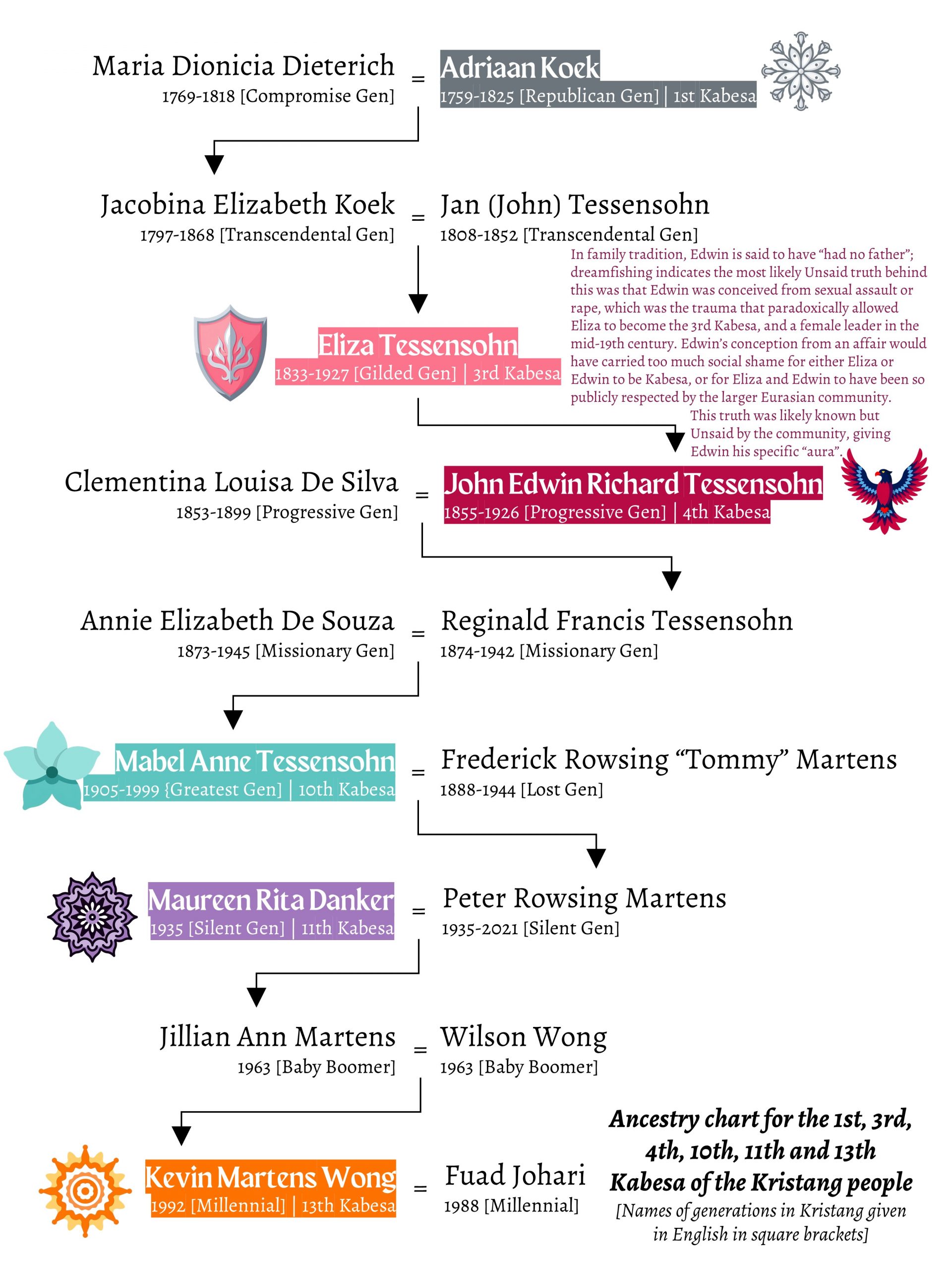
This historical reality makes modern surname anxieties not only unnecessary but ahistorical, something which is sharpened into even clearer relief when one considers adoption paradigms:
• Dr Charles Joseph Pemberton Paglar (1894-1954), the 8th Kabesa
He was an orphan from an unknown and possibly very brief relationship who was found abandoned at a convent in Penang, demonstrating that Kristang society accepted and elevated individuals not because of surname or ancestry, but because of character, contribution, and community integration. As Rex Shelley and Chen Fen write in their authoritative biography Dr Paglar: Everyman’s Hero (2010),
Charles Paglar was hardly an English rose. His rather swarthy looks spoke loudly of the Asian side of his parentage.
Not much is known of Charles Paglar’s mother, but from the colour of his skin, hair and eyes, it was obvious that she was Indian. This unidentified woman, name unknown, gave birth to him on 1 September 1894 in Batu Gajah, a town in the Malayan state of Perak. … A liaison between a young woman from that community and a British planter is not inconceivable. The result of such a union could well have been an unwelcome addition to the young woman’s life. So it was that the baby born of an Indian mother and an English father was eventually sent away to a convent more than 150 kilometres away in Penang.
pp. 12-13
Thus, the community has never required “pure” Portuguese or European ancestry as a condition of being Kristang, even and especially from its very earliest instantiations.
5. Why do Kristang people sometimes have Chinese, Malay, Indian, or other surnames?
Because Kristang communities historically lived in port cities shaped by:
- Intermarriage
- Conversion
- Trade networks
- Adoption
- Orphan integration
- Need for survival under colonial authorities
These conditions produced creole naming ecologies, not rigid European naming lines.
A Chinese surname in a Kristang family simply reflects this lived history.
During the Japanese Occupation, a significant number of Kristang families hid some of their children with Malay families to protect them from the Japanese military administration, who were deeply suspicious of any European ties or connections. Some of these children continued to be raised Malay and Muslim after the war, but later in life also reclaimed their identity as Kristang or Eurasian for various reasons.
Many people from the Armenian and Jewish communities also intermarried with Kristang and Eurasian people to the extent that surnames like Galistan and Meyer have also been incorporated into Kristang.
The De Silva, De Souza, Pereira and a number of other major Kristang surnames have Indian-origin, Sri Lankan-origin and/or Portuguese-origin sources, with some families none the wiser as to which came from where first.
And Kevin’s own Kristang language teacher when Kevin was first recovering his true heritage and identity, the indomitable Bernard Stephen Mesenas, was always also very proud of his Filipino ancestry.
We can only gain from the respect we show to all the communities who make up who we are.
This revitalisation effort, and this Resurrection Language, are the work of everyone who calls Malaya home, and who has contributed to making it home.
In a world fragmenting into collapse, essentialism, neo-tribalism and neo-fascism, a reclamation of the plurality of what it means to be Kristang is not optional.
It is necessary, because it reminds us of the great diversity and fluidity inherent in being human at all.
6. Does having a Chinese surname make the 13th Kabesa “less Kristang”?
Absolutely not.
Kristang identity is cultural, communal, creolised, and lineage-deep — not determined by surname.
The 13th Kabesa’s ancestry includes:
- The aforementioned line through Adriaan Koek and Maria Dieterich
- Centuries of Southeast Asian creolisation
- The full historical continuity of Kristang leadership roles
A surname does not diminish this; it embodies it.
7. So why did confusion arise in the first place?
Because for over a century, various groups and interests in the Straits Settlements repeatedly demanded that Straits Settlements and colonial-era British society clarify “Who counts as Eurasian?” For example. appeals for definitions appeared in the Straits Settlements newspapers in 1888, 1890, 1897, 1901, 1926, 1939, 1946 and 1948, with the Perak Eurasian Association attempting to draft a formal definition in 1948. But these were anxieties that arose from living under the racial hierarchies of British imperial colonialism, not Kristang realities. People today often inherit those colonial assumptions without realising they were never the real Kristang norms to begin with.
8. Singapore’s institutions have already shifted toward the Kristang paradigm of identity since the 1990s
Since 1994, Singapore’s official treatment of “Eurasian” identity has moved steadily toward the aforementioned Creole-Indigenous Kristang paradigm of identity: contextual, negotiated, creole, and based on lived cultural belonging rather than rigid racial formulas.
8.1 Before 1994: the British-inherited patrilineal racial rule
As the book Singapore Chronicles: Eurasians by the 29th Singapore Eurasian Association president Alexius Anthony Pereira (2015) documents on pp. 79-84, the rigid rule that only persons with Eurasian fathers or a Eurasian surname inherited from their father could be classified as Eurasian was a British colonial administrative rule, carried forward mechanically after Independence.
This rule did not reflect Kristang lived practice, which had quietly always allowed:
- maternal transmission of identity
- situational and contextual self-classification
- integration of outsiders
- plural ancestries
- religious conversion
- surname fluidity
- community-recognised belonging
- and assimilation via culture, not “blood”
and, if one is still concerned about aligning with Portugal: Portuguese people today generally have at least two surnames — meaning that in this case, Kevin would indeed actually be more Portuguese in spirit than most Kristang people, since both his mother’s surname and his father’s surname are part of his legal name.
8.2 1994: a major shift
On Tuesday, 29 March 1994, after a vote at the Singapore Eurasian Association Annual General Meeting that passed “with more than two-thirds of votes cast”, the EA formally changed its constitution to allow classification as Eurasian through either parent, and had this amended definition published in The Straits Times on Friday, 1 April 1994.
Table 7 from page 82 of Singapore Chronicles: Eurasians (2015) by 29th Singapore EA president Alexius Anthony Pereira (president from 2018 to 2022)
EA’s Definition of “Eurasian”
| Version 1988 |
| 4 Ordinary Membership (a) All Eurasian Singaporeans and Permanent Residents of the age of eighteen and above, both male and female, as hereinafter specified shall be eligible for Ordinary and Life Membership. (b) A Eurasian for the purposes of these Rules only is a person: (i) Who is Singaporean by birth or Registration or a Permanent Resident; and (ii) Whose father or any whose male progenitors in the male line is or was of European descent and whose name is etymologically European. |
| Revised Version 1994 |
| 4 Ordinary Membership (a) All Eurasian Singaporeans and Permanent Residents of the age of eighteen and above, both male and female, as hereinafter specified shall be eligible for Ordinary and Life Membership. (b) A Eurasian for the purposes of these Rules only is a person: (i) Who is both of European and Asian ancestry; OR (ii) Whose family has been accepted as Eurasian by custom and tradition. |
This was a turning point:
Singapore’s institutions began reflecting Kristang-oriented realities when it came to Eurasians, not colonial-era British racial bureaucracies.
The updated rules recognised:
- mixed descent on either side
- lived cultural affiliation
- community practice
- non-racial criteria in defining “Eurasian”
Exactly as Kristang communities had quietly practised for over 300 years.
By doing so, Singaporean institutions implicitly affirmed:
Eurasian (and Kristang) identity cannot be reduced to surnames, paternal lines, or blood quantum.
Both are cultural, historical, communal, and lived.
8.4 The Kristang model was always the more accurate one
The majority of Kristang society in Malacca and Singapore has never enforced rigid descent rules.
Historical evidence from:
- the assimilation of the Angelbeek, Hendricks, Marbeck, Danker, Hendroff, Koek, Rappa, Neubronner, Westerhout, Minjoot, Spykerman, Especkerman and many other Dutch-Eurasian families into Kristang to such a degree that some Kristang people accidentally still identify some of these surnames as Portuguese origin, and the similar assimilation of surnames from other communities beyond Dutch origin into Kristang such Scully, Rée, Galistan, Woodford, Leicester, Scharnguivel etc.
- the assimilation of freed slaves (Makassarese, Bengali, Indian, Sinhalese)
- Catholic/Protestant/Muslim/Jewish crossovers and other religious converts
- documented and substantial records of situational identity shifting or fluid performing, including between class lines that were otherwise thought to be rigid (as described by Fernando, Sim & De Witt, etc.)
- the absorption of orphans and adoptees (e.g., Dr Charles Paglar, 8th Kabesa)
all demonstrate that Kristang identity:
- was always relational rather than racial
- always creole rather than genealogically narrow
- always about cultural participation and respect, not paternal descent
- always multi-ethnic, multi-religious, and multi-status
This is the model Kodrah Kristang also champions, because it is what gives our community its consistency of tenderness, openness and relationality that has helped us survive and thrive.
8.5 What this means for the present Kabesa
By the time the 13th Kabesa was born (1992), and especially once Singapore changed its classification rules (1994), the state’s understanding of Eurasian identity had already begun to align with the centuries-old Kristang epistemology of identity.
Thus:
A Kabesa with a Chinese surname is not a contradiction — it is exactly how Kristang identity has always worked. And it is fully consistent with how Singapore’s national institutions themselves have understood Eurasian belonging for more than three decades.
The 13th Kabesa does not sit outside modern institutional norms.
Modern institutional norms have slowly moved toward the Kristang way.
9. What is the correct way to understand the 13th Kabesa’s surname today?
It is a testament to Kristang creolisation, not a deviation from it.
The 13th Kabesa’s Chinese surname reflects:
- The multi-ethnic realities of Kristang ancestry
- The historical openness of Kristang communities
- The fact that Kristang identity is based on culture, individuation, and belonging, not colonial racial categories
- The continuity of a lineage that has always absorbed outsiders and shaped them into leaders
In Kristang cosmology and civilisational history, this is exactly how the community survived five centuries.
10. Portuguese-Eurasian origins remain foundational to Kristang — and a Chinese surname does not contradict this
Kristang civilisation is indisputably rooted in Portuguese-Eurasian history, shaped by the arrival of Portuguese settlers, soldiers, casados, members of other mestiço communities, religious orders, and the early Casado families who emerged from these early encounters. This Portuguese origin-point is a historical fact and remains an indisputable central pillar of Kristang cultural memory, language, the Kodrah Kristang revitalisation effort, and Kristang identity.
However, the presence of Portuguese ancestry and the presence of a Portuguese-origin surname are not the same thing.
Kevin having a Chinese surname does not detract from:
- the Portuguese-Eurasian foundations of Kristang culture
- the linguistic origins of Kristang
- the historical and genealogical continuity of the Kabesa line
- the fact that Kristang identity emerges from 150 years of initial Luso-Asian creolisation
- the continuing respect and esteem Kevin has for all psychoemotionally healthy parts of the culture and language that originated from Portugal, which remain a very significant component of what it means to be Kristang
Kristang identity is Portuguese in origin, but creole in nature — meaning that it has always also included Malay, Indian, Chinese, Dutch, African, Makassarese, Sinhalese, Armenian, Jewish, and orphan / freed-slave ancestries from its earliest centuries. This creolisation is not erosion; it is the mechanism by which Kristang culture survived.
Thus:
A Chinese surname does not erase Portuguese-Eurasian roots.
It coexists with them — exactly as the first Dutch Kristang, Armenian Kristang, Jewish Kristang, Malay Kristang, Indian Kristang, British Kristang, Scottish Kristang and Peranakan Kristang families did.
Kevin’s surname therefore does not diminish or displace the Portuguese foundations of Kristang culture. Instead, it affirms the historical reality that Kristang identity has always integrated new ancestries while retaining its cultural origin-point in the Luso-Asian world.
11. Kristang has evolved beyond any remaining need for surnames as primary identity anchors
For much of the late nineteenth and twentieth centuries, many Kristang people very understandably clung to surnames because everything else was just being fucking stripped away. Under colonial categorisation that already occluded most Creole-Indigenous elements of Kristang ways of being and alongside forced assimilation, language loss, urban displacement, and other institutional racial frameworks, a surname often became the last surviving visible marker of Kristang continuity.
It was never a fixed cultural rule — it was a survival reflex during a period of erasure.
But Kristang is no longer in that state.
Today, through revitalisation, language recovery, Creole-Indigenous philosophy, community rebuilding, and the re-establishment of Kristang civilisational sovereignty, the culture no longer needs surnames to primarily signal legitimacy, continuity, or belonging. We once very understandably depended on surnames because external systems demanded visible proof that we were still here.
Now, we stand on our own terms, because we are here.
Our identity rests in:
- our language
- our philosophy
- our memory
- our individuation and community belonging
- our lived culture
- our creole ancestry
- our ethics, our values, and our relationality
- our tenderness
- our courage
- our rascal joy and deep beautiful bittersweetness
- and our brave yearning for a better world
Not in a name inherited through colonial administrative structures.
Surnames were once a tool of recognition when everything else was under threat.
They are no longer necessary for that.
Because so many people recognise us now.
Across Singapore, Malaya, and far beyond, countless non-Kristang people now respect and esteem the Kristang community precisely because of how much we have dared to step forward after centuries of erasure.
In both Singapore and Malacca, and in our own beautiful and context-specific ways, we have reclaimed our language and encouraged the young to love it and live it again.
We have rebuilt and reembodied a civilisational philosophy that was almost lost and never even defined or recognised.
We speak openly about the traumas of colonisation, oppression, racism, homophobia, ableism and mixed ancestry where so few other people can.
We have created a revitalisation movement powered entirely by community tenderness; taught hundreds of non-Kristang people a language that so many unfairly said was once almost extinct; and shown the world that a tiny community on the sidelines of history can still move with extraordinary dignity, generosity, and courage.
The respect we receive — from all seven living generations, other Indigenous and cultural leaders, civil servants, scholars, linguists, Singaporeans, Malaysians, local communities, and people around the world — reflects how deeply our refusal to disappear has inspired others to reclaim their own languages and identities.
Kristang identity today is strong enough to speak for itself — in our own language, on our own identity and values, in our own philosophical framework, and through our own people.
Look at all we have done together.
Look at all we are still going to do together.
We do not need surnames to validate who we are.
We are Kristang because we live Kristang.
Because we are alive.
We are thriving like we have never thrived before.
And because, finally, after five centuries of survival, fragmentation, erasure, and revival:
We stand by ourselves, for ourselves, as ourselves — at last.
Let our identity and our deep unity be the strongest markers of who we are now.
Our surnames reflect core parts of our history, our traditions, our ways of thinking and our stories.
Let the rest of those histories, traditions, ways of thinking and stories now finally shine through as well.
12. What is the simple answer?
The 13th Kabesa has a Chinese surname because Kristang identity has never needed to depend on surnames — and never needed to depend on being “European.” It first and foremost needs to depend on being Kristang.
And Kristang people have always been proudly, fiercely creole.
When he was a student and in line for the annual Eurasian Association Singapore prizegiving ceremony, the 13th Kabesa used to hear things like
“Why so many yalams in this queue?”
“These Chinese people come here and take all our awards.”
“No one is pure Eurasian anymore.”
And he used to think,
what the fuck did it even mean to be pure Eurasian, ever, to begin with?
Kodrah Kristang and the 13th Kabesa embrace and respect all people who recognise, affirm and love what it means to be Kristang, who honour their Kristang inheritance, identity, language and way of being, whatever that means, and from whichever kind of blood family or found family, progenitor race, religious or spiritual experience, sexuality, gender, neurotype or nationality — Portuguese, Malay, Dutch, British, Armenian, Malayalee, Tamil, Hokkien, Peranakan, Hakka, Teochew, Javanese, New Eurasian, Singaporean, Malaysian, Malayan, Australian and more.
Ardansa sempri kureh na sanggi.
Sanggi numistih falah mintira di ardansa.