
Kristang short fiction enters the Singapore and Malayan literary imagination through a wound. As documented by former Singapore Eurasian Association President Alexius Anthony Pereira in the 2015 volume Singapore Chronicles: Eurasians, arguably the earliest widely circulated portrayal of a Eurasian/Kristang-coded protagonist in national literature was not written by a member of the community, nor was it sympathetic. It was “Kenneth Jerome Rozario,” a story and character from Catherine Lim’s Or Else, the Lightning God and Other Stories (1980), thrust into canonical visibility when the Ministry of Education selected the collection for O-level literature in 1988. For many Eurasian readers, this was their first encounter with a version of themselves sanctioned for classroom study: a “lazy, disco-going, good-time Charlie,” paired with a perpetually drunk godmother caught in cycles of violence. The issue was not merely that the representation was reductive—it was that this caricature, unchallenged by alternative narratives, became institutionalised as the state-approved template for how Eurasian lives could be imagined.
This episode crystallised two structural problems that later Kristang short fiction would spend decades addressing. First, it showed how easily communities without narrative control could be flattened into stereotype by majority writers and legitimised by state curricula. Second, it revealed a vacuum: the near-total absence of Kristang or Eurasian self-representation in Singapore’s literary field. In this sense, “Kenneth Jerome Rozario” becomes less a single offensive portrayal and more a diagnostic flashpoint. It exposes what happens in a cultural ecology where Kristang voices have not yet entered print in sustained ways. For the next generation of writers, it arguably quietly became the foil—the negative image—against which agency, nuance, complexity and creole self-authorship must be reclaimed.
It is into this vacuum that the earliest recognisable forms of “consciously” Kristang and Eurasian short fiction begin to emerge in the late twentieth century. Works like Enrico C. Varella’s Hear the Earth Cry (1992) and Dudley De Souza’s Lady by the Gatepost (1993) place Eurasian names, streets, and sensibilities at the centre of their narratives, even if Kristang language or cosmology remain lightly implied rather than foregrounded. These collections are not yet explicit declarations of Kristang literary sovereignty, but they matter profoundly because they counter the representational imbalance made stark by “Kenneth Jerome Rozario.” They show, for the first time in published English-language fiction, that Eurasian lives can be rendered with emotional interiority, dignity, and social context—without collapsing into caricature. Subsequent “nationally-oriented” anthologies such as Denyse Tessensohn’s Singapore Heads and Tales (1995), which was awarded the Singapore Literature Prize (Merit) in 1994, extend this work by blending memoir, anecdote and fiction to map how communities navigated state multiculturalism, migration, class mobility and the slow fading of kampong-era communal life. Together, these early publications form a proto-canon: a set of texts that begin to assert that Kristang and Eurasian stories belong in Singapore literature not as stereotypes or exceptions, but as part of the fabric of national narrative life. They also prepare the ground for the more explicitly Kristang-centred fiction that will emerge two decades later, reclaiming the representational terrain that “Kenneth Jerome Rozario” had once dominated by default.
Through the 2000s and early 2010s, short fiction emerging from Singapore’s urban milieu began to explore more experimental and emotionally layered modes of storytelling. Collections like Wayne Rée’s Tales from a Tiny Room (2014) thread speculative and psychological themes through city corridors, rooftops, lifts, and MRT stations—compressing urban experience into tightly wrought snapshots of isolation, connection, and interior upheaval. In Gemma Pereira’s works “The Terrarium”, “The Tissue-paper Man” (2012) and “Mama at Owen Road” (2015) this urban lens is extended throughout more introspective and domestic frames, capturing the city not as backdrop but as emotional container—claustrophobic, familiar, and quietly estranging. While these pieces do not foreground Eurasian and Kristang cultural identity explicitly, they mark a turn toward the particular approach to urban mapping that Eurasianness and Kristangness embody: charting the contradictions, pressures, ambiguities, and everyday negotiations of life in a rapidly modernising metropolis.
From the mid-2010s, this emerging Eurasian and Kristang short story strand, with more overtly Eurasian and/or Kristang-coded protagonists, thereafter begins to crystallise. Nicola Koh’s “The Bride of Christ” (2016) and Angela Jesse Michael’s “The Walking Women” (2016) deploy gothic, speculative and religious motifs to articulate this shift, while Arin Alycia Fong’s “Walking on Water” (2019) blends deep anxieties about climate change and creole memory in ways that resonate with Kristang maritime history. Crucially, Melissa De Silva’s hybrid anthology Others Is Not A Race (2017) — winner of the 2018 Singapore Literature Prize — thereafter marks a major breakthrough for the canon in the same vein. Through its mix of short stories, essays and vignettes, the book confronts state categories, everyday racism and the psychic costs of being labelled “Other,” finally explicitly placing Eurasian and Kristang-adjacent lives and perspectives unapologetically at the centre of Singapore’s literary map. Together, these works significantly widen the thematic range of Kristang short fiction: Kristang and Eurasian characters are no longer only unconsciously liminal, guardians of tradition or nostalgic figures, but concrete protagonists navigating desire, hauntings, environmental anxieties, bureaucratic misrecognition and structural violence.
The 2020s then see an acceleration and consolidation of Kristang short fiction into a more visibly interconnected and symbolically-loaded field. Arin Alycia Fong’s The unsullied tongue of Saint Anthony and other miracles (2020), a collection of magical-realist short stories, stands out as a major landmark: it uses miracles, relics and bodily transformation to think about language loss, migration and mixedness, and at least one story explicitly centres Kristang and Catholic creole sensibilities. Around this, a cluster of short stories by Wayne Rée and Stuart Danker – Wayne’s “Down Under the Waters” (2022) and “To Ashes” (2022), Stuart’s “Insert Credit to Continue” (2022) and “Up in Flames” (2023) – continue to unconsciously weave deeper motifs of hybridity and boundary-crossing into speculative, horror and gaming-inflected scenarios. They show how Kristang themes can inhabit genre frameworks that are recognisably contemporary: monsters in reservoirs, digital afterlives, and urban fires become vehicles for surfacing themes related to erased histories and precarious identities. A parallel and equally important strand emerges through stories that directly anchor themselves in Kristang folklore, spaces and language. Patricia Maria De Souza’s “Kaza Bazitu di Rua Tessensohn / The Empty House in Tessensohn Road” (2021) is a key example: it uses a haunted house in a historically Kristang-linked street to explore abandonment, memory and the afterlives of community spaces. Sara Frederica Santa Maria’s “The Gut Demons” (2021), a short story–folk recount hybrid, turns digestive illness into an allegory for intergenerational trauma and unprocessed histories. Together with earlier pieces like Wayne Rée’s “Walking on Water” and Gemma Pereira’s work, these stories anchor the canon geographically: Kristang short fiction is not abstract myth but rooted in specific roads, rivers, flats and bodies.
Within this expanding ecosystem, a substantial cycle of Kristang-centred short stories by the 13th Kabesa Kevin Martens Wong finally play an expansively and paradoxically stabilising role—precisely because it is the first body of Kristang fiction to directly confront, invert and finally begin to heal the representational wound opened by “Kenneth Jerome Rozario” forty years earlier. Beginning with “A Merlion for His Majesty”, which won the NUS Creative Writing Competition in 2015 and was published in the now-defunct LONTAR: The Journal of Southeast Asian Speculative Fiction in 2018, Kevin reimagines a militarised Singapura kingdom where princes bond with semi-sentient merlions, queering both national iconography and creole myth; in doing so, he replaces the externally imposed caricature of the Eurasian male with an Indigenous, sovereign, mythic protagonist who refuses reduction. In 2022, “Looking Glass” turns a boy’s memory of his mother’s window drawings into a meditation on grief, inheritance and art-making in a Kristang household—writing interiority, tenderness and self-recognition back into a literary space that once allowed only stereotype. From 2023 to 2025, this representational reclamation further accelerates through a dense cluster of interlinked stories: “Alabanda”, “Amateurs”, “Another Dreamtiger”, “Festa San Pedru, 5511 CE”, “Island End”, “The Ship”, “There is no word for gay in the Kristang language”, “Edenheart”, “Nus Nubu Sta Prendeh Sunyeskah / We Are Learning How To Dreamfish Again”, and “This Stirring Love”. Taken together, they move across time from precolonial myth and alternate history to far-future festivals in 5511 CE, time-travel comedies about queer terminology, colonial theatre troupes, and speculative ships carrying Kristang futures through climate collapse. In each mode, Kristang protagonists are granted complexity, agency, sensuality, anger, humour, futurity—the full dimensionality denied to Kenneth Jerome Rozario and his godmother. Nus Nubu Sta Prendeh Sunyeskah, which won the 2024 Unearthodox Voices of Regeneration Top Prize, completes this turn: it not only fuses ecological collapse, dreamfishing, Indigenous resurgence and queer tenderness into a compact narrative, but reveals the fourth-person personified collective orientation in Kristang to the general public for the first time. In the same way, Kevin’s stories not only echo and exponentiate themes developed by earlier and parallel writers finally fully answer—and overwrite—the reductive frame that once dominated the national imagination, offering instead a new collective creole futurism in which Kristang characters are not mis-seen from the outside but self-seen, mythically and gloriously, from within.
Today, the living Kristang short story field is genuinely polyphonic. Writers and cultural workers such as Angela Jesse Michael, Arin Alycia Fong, Denyse Tessensohn, Gemma Pereira, Kane Wheatley-Holder, Kevin Martens Wong, Patricia Maria De Souza, Melissa De Silva, Sara Frederica Santa Maria, Stuart Danker and Wayne Rée have contributed an eclectic range of tales across genres and media. Some focus on realist family narratives; others gravitate toward horror, speculative fiction, magical realism, or hybrid comics-prose forms. The canon of Kristang short stories is therefore not a closed shelf of “pure” Kristang-language texts, but a creole, relational and evolving reef: English, Kristang and Malay intermingle; queer and straight characters share the same fictional streets; ghosts, tanks, merlions and river gods stand beside grandparents, office workers and theatre amateurs. What binds these works together is not a single language or aesthetic, but a shared commitment to making Kristang and Eurasian lives, memories and futures visible on the page, one distilled story at a time.
List of all known short stories published by writers identifying as Kristang or containing significant Kristang-related material
Please contact Kodrah Kristang at kodrahkristang at gmail dot com to suggest new material to be added to this list, and/or to have material removed or altered if it has been placed here inaccurately.
Works published during the term of service of the 13th Kabesa (2015-2075)
Tuan Raja Naga Ultramar Kevin Martens Wong Zhi Qiang
2026 (Kristang year 514-515 | 13th Kabesa, year 11)
A Resonance in the Wind. Short story by Kevin Martens Wong in Kakantiga Ultra / Cantos from the Beyond.
A Room with a Truth. Short story by Kevin Martens Wong in Kakantiga Ultra / Cantos from the Beyond.
A Story Told On Its Own Terms. Short story by Kevin Martens Wong in Kakantiga Ultra / Cantos from the Beyond.
Everyone’s Right of Way. Short story by Kevin Martens Wong in Kakantiga Ultra / Cantos from the Beyond.
Greener on Every Side. Short story by Kevin Martens Wong in Kakantiga Ultra / Cantos from the Beyond.
Growing Pains. Short story by Kevin Martens Wong in Kakantiga Ultra / Cantos from the Beyond.
How We Would Like To Be Remembered. Short story by Kevin Martens Wong in Kakantiga Ultra / Cantos from the Beyond.
In What Dares to Remain. Short story by Kevin Martens Wong in Kakantiga Ultra / Cantos from the Beyond.
Made To Be Unbroken. Short story by Kevin Martens Wong in Kakantiga Ultra / Cantos from the Beyond.
Making Space. Short story by Kevin Martens Wong in Kakantiga Ultra / Cantos from the Beyond.
Music of the Spheres. Short story by Kevin Martens Wong in Kakantiga Ultra / Cantos from the Beyond.
Nightplay. Short story by Kevin Martens Wong in Kakantiga Ultra / Cantos from the Beyond.
No Further Escalation. Short story by Kevin Martens Wong in Fallen in Love.
One and the Same. Short story by Kevin Martens Wong in Kakantiga Ultra / Cantos from the Beyond.
Same Time Tomorrow. Short story by Kevin Martens Wong in Kakantiga Ultra / Cantos from the Beyond.
Stay. Short story by Kevin Martens Wong in Kakantiga Ultra / Cantos from the Beyond.
Storm-Built. Short story by Kevin Martens Wong in Kakantiga Ultra / Cantos from the Beyond.
Symphonic. Short story by Kevin Martens Wong in Kakantiga Ultra / Cantos from the Beyond.
Temporary Permanence. Short story by Kevin Martens Wong in Kakantiga Ultra / Cantos from the Beyond.
The Arvahang Eats a Kabesa. Short story by Kevin Martens Wong in Kakantiga Ultra / Cantos from the Beyond.
The Bravest One Has Ever Felt. Short story by Kevin Martens Wong in Kakantiga Ultra / Cantos from the Beyond.
The Feelings Worth Following. Short story by Kevin Martens Wong in Kakantiga Ultra / Cantos from the Beyond.
The Pace. Short story by Kevin Martens Wong in Kakantiga Ultra / Cantos from the Beyond.
The Rude Ghost Graph. Short story by Kevin Martens Wong in Kakantiga Ultra / Cantos from the Beyond.
Unconditional Love Story. Short story by Kevin Martens Wong in Kakantiga Ultra / Cantos from the Beyond.
Voice of a Wandering Sea. Short story by Kevin Martens Wong in Kakantiga Ultra / Cantos from the Beyond.
Water from the Rock. Short story by Kevin Martens Wong in Kakantiga Ultra / Cantos from the Beyond.
Your Turn. Short story by Kevin Martens Wong in Kakantiga Ultra / Cantos from the Beyond.
2025 (Kristang year 513-514 | 13th Kabesa, year 10)
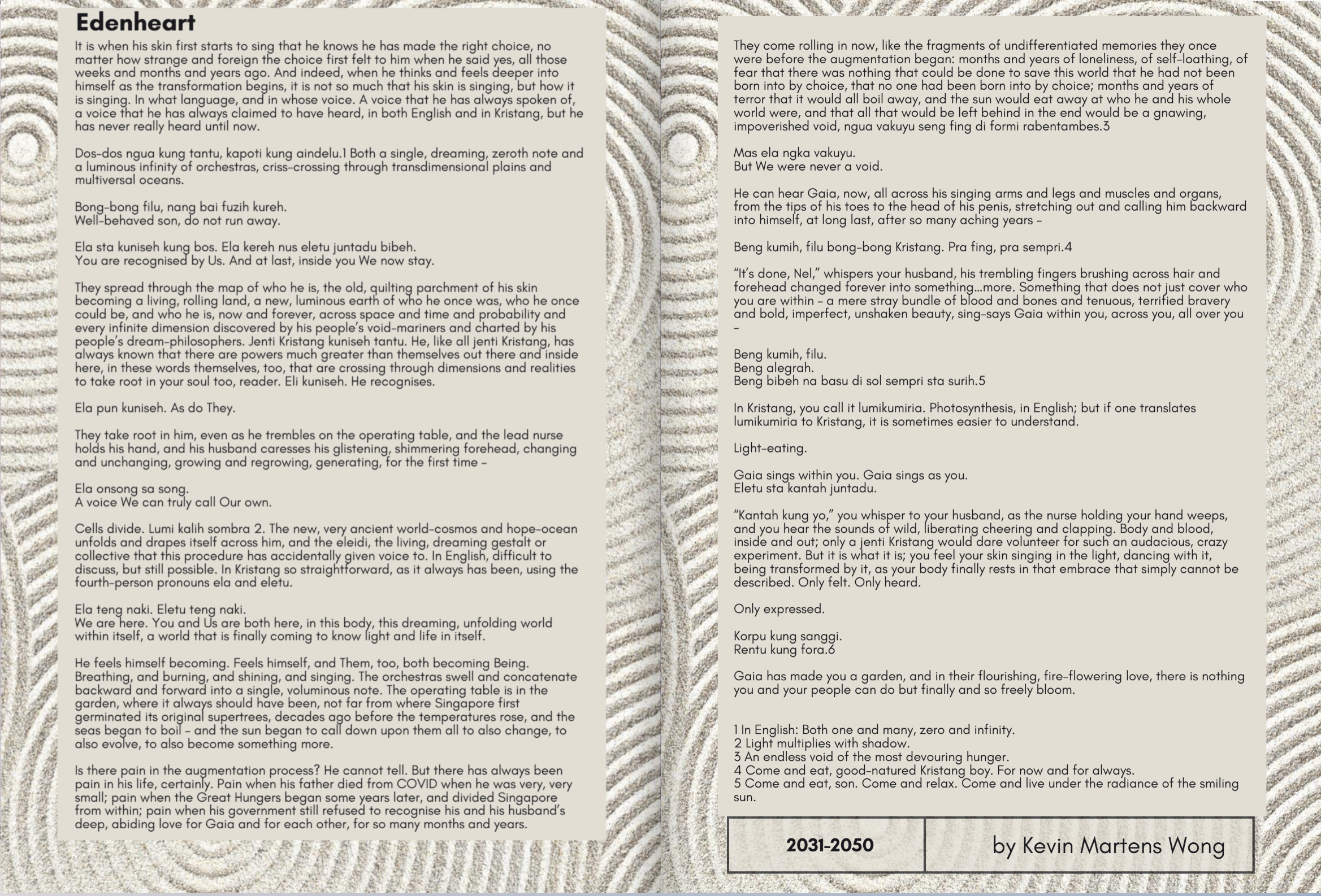
Edenheart. Short story by Kevin Martens Wong in Climateverse Futurescapes.
This Stirring Love. Short story by Kevin Martens Wong in Shakespeare Reimagined: Contemporary Interpretations and Creative Adaptations in Arts-Based Research.
2024 (Kristang year 512-513 | 13th Kabesa, year 9)
Nus Nubu Sta Prendeh Sunyeskah / We Are Learning How To Dreamfish Again. Short story by Kevin Martens Wong in Unearthodox: Voices of Regeneration. 2024 Unearthodox Voices of Regeneration Top Prize winner.
2023 (Kristang year 511-512 | 13th Kabesa, year 8)
Alabanda. Short story by Kevin Martens Wong in Immigrant Sci-Fi Short Stories.
Amateurs. Short story by Kevin Martens Wong in The Second Link: An Anthology of Malaysian and Singaporean Writing.
Festa San Pedru, 5511 CE. Short story by Kevin Martens Wong in हाकारा । hākārā.
Island End. Short story by Kevin Martens Wong in Singapore Unbound.
The Ship. Short story by Kevin Martens Wong in Sploosh.
There is no word for gay in the Kristang language. Short story by Kevin Martens Wong in PR&TA: Practice, Research & Tangential Activities.
Up in Flames. Short story by Stuart Danker in A Spoonful of Malaysian Magic.
2022 (Kristang year 510-511 | 13th Kabesa, year 7)
Down Under the Waters. Short story by Wayne Rée in Fish Eats Lion: New Singaporean Speculative Fiction.
Insert Credit to Continue. Short story by Stuart Danker in Fish Eats Lion: New Singaporean Speculative Fiction.
Looking Glass. Short story by Kevin Martens Wong in Non-Binary Review.
New Beginnings. Short story by Nilanjana Sengupta in Chickpeas to Cook & Other Stories.
To Ashes. Short story by Wayne Rée in Best New Singaporean Short Stories: Volume Five.
2021 (Kristang year 509-510 | 13th Kabesa, year 6)
Kaza Bazitu di Rua Tessensohn / The Empty House in Tessensohn Road. Short story by Patricia Maria De Souza.
The Gut Demons. Short story/recount by Sara Frederica Santa Maria.
2020 (Kristang year 508-509 | 13th Kabesa, year 5)
The unsullied tongue of Saint Anthony and other miracles: A collection of magical realist short stories. Short story anthology / Master’s thesis by Arin Alycia Fong.
2019 (Kristang year 507-508 | 13th Kabesa, year 4)
Walking on Water. Short story by Arin Alycia Fong in In This Desert, There Were Seeds.
2018 (Kristang year 506-507 | 13th Kabesa, year 3)
A Merlion for His Majesty. Short story by Kevin Martens Wong in LONTAR: The Journal of Southeast Asian Speculative Fiction. 2015 NUS Creative Writing Competition winner.
Satay. Short story by Wayne Rée in LONTAR: The Journal of Southeast Asian Speculative Fiction.
2017 (Kristang year 505-506 | 13th Kabesa, year 2)
Others Is Not A Race. Mixed genre anthology by Melissa De Silva. 2018 Singapore Literature Prize winner.
2016 (Kristang year 504-505 | 13th Kabesa, year 1)
It Happened At Mount Pleasant. Short story by Melissa De Silva in Quarterly Literary Review Singapore.
The Adventures of Bear Man. Short story by Melissa De Silva in Quarterly Literary Review Singapore.
The Bride of Christ. Short story by Nicola Koh in A-Minor.
the sheets we drape over the things we don’t say. Short story by Arin Alycia Fong in this is how you walk on the moon.
The Walking Women. Short story by Angela Jesse Michael in Twenty-Two Asian Short Stories.
Works published during the term of service of the 12th Kabesa (1991-2015)
Puan Api Menari Valerie Scully
2015 (Kristang year 503-504 | 12th Kabesa, year 24)
Mama at Owen Road. Short story by Gemma Pereira in The Epigram Books Collection of Best New Singaporean Short Stories: Volume Two.
2014 (Kristang year 502-503 | 12th Kabesa, year 23)
Tales from a Tiny Room. Short story anthology by Wayne Rée.
2013 (Kristang year 501-502 | 12th Kabesa, year 22)
Eurasians At The Grassroots. Short story anthology by Dennis De Witt.
2012 (Kristang year 500-501 | 12th Kabesa, year 21)
The Terrarium. Short story by Gemma Pereira in Quarterly Literary Review Singapore.
The Tissue-paper Man. Short story by Gemma Pereira Quarterly Literary Review Singapore.
2000 (Kristang year 488-489 | 12th Kabesa, year 9)
Realities. Short story by Dudley Patrick De Souza in Singa.
1995 (Kristang year 483-484 | 12th Kabesa, year 4)
Singapore Heads and Tales. Anthology by Denyse Tessensohn. 1994 Singapore Literature Prize (Merit) winner.
1993 (Kristang year 481-482 | 12th Kabesa, year 2)
Lady by the Gatepost. Short story anthology by Dudley De Souza.
1992 (Kristang year 480-481 | 12th Kabesa, year 1)
Hear the Earth Cry: A Collection of Short Stories. Short story anthology by Enrico C. Varella.
Works published during the term of service of the 10th Kabesa (1969-1989)
Puan Bunga Besi Mabel Martens
1981 (Kristang year 469-470 | 10th Kabesa, year 13)
The Decision. Short story by Patricia Maria Tan née De Souza in Singa.
1980 (Kristang year 468-469 | 10th Kabesa, year 12)
Kenneth Jerome Rozario. Short story by Catherine Lim in Or Else, The Lightning God and Other Stories.
1978 (Kristang year 466-467 | 10th Kabesa, year 10)
Miss Pereira. Short story by Catherine Lim in Little Ironies.
Unique Features of Kristang Short Stories
Kristang short fiction occupies a distinctive place within Southeast Asian and diasporic literature. It is shaped by Creole-Indigenous ways of seeing, remembering, and surviving that differ markedly from dominant European narrative traditions. Rather than functioning primarily as vehicles for plot or moral resolution, Kristang short stories often operate as sites of encounter—between past, present, possible and future, between self, the other, community and reality itself, and between intimacy, in/visibility, integrity and interpretation on multiple levels of meaning.
1. Episodic Structure over Linear Plot
Many Kristang short stories favour episodic or vignette-based structures rather than tightly plotted arcs. Moments, impressions, conversations, or remembered scenes are placed alongside one another without requiring a single climactic resolution.
This reflects a cultural experience in which life has often unfolded through interruption, migration, and adaptation rather than continuity. Meaning accumulates through juxtaposition rather than causality, allowing readers to assemble significance across fragments.
2. Intimacy as Narrative Scale
Kristang short stories frequently operate at an intimate scale. They are often concerned less with grand events than with small domestic moments: a meal, a family argument, a childhood memory, a brief encounter, a quiet act of care or cruelty.
This focus is not a retreat from history but a way of accessing it. In Kristang storytelling, large forces—colonialism, state policy, migration, religious authority—are experienced most truthfully through how they shape everyday relationships.
3. Embedded Orality and Spoken Texture
Even when written in English, Kristang short stories often retain the texture of oral storytelling. Dialogue may carry rhythmic repetition, code-switching, or indirect address. Narrators may sound conversational, reflective, or confessional rather than formally detached.
This oral inheritance produces stories that feel as though they are being told rather than simply written, preserving the sense that narrative knowledge is shared relationally rather than authored in isolation.
4. Memory as Active Reconstruction
Memory in Kristang short stories is rarely stable or authoritative. Narrators often question their own recollections, contradict themselves, or acknowledge gaps in what they know. The act of remembering becomes part of the story itself.
This reflects a broader Kristang historical condition in which records were partial, erased, or externalised. Short fiction therefore becomes a space where memory is actively reconstructed—tentative, emotional, and aware of its own limits.
5. Cultural Knowledge without Explanation
Kristang short stories often assume shared cultural knowledge without pausing to translate or justify it. Food, kinship terms, neighbourhood dynamics, religious rituals, and social tensions may appear without glossing.
This narrative stance resists the expectation that marginalised cultures must always explain themselves to an external reader. Instead, the story centres Kristang experience as sufficient and self-legitimising.
6. Quiet Irony and Emotional Restraint
Rather than dramatic confrontation, Kristang short stories often rely on understatement, irony, and emotional restraint. Pain, disappointment, and injustice may be revealed obliquely—through silence, missed connections, or what remains unsaid.
This tonal quality mirrors survival strategies developed in environments where open confrontation was risky. The result is fiction that rewards attentiveness and emotional literacy rather than spectacle.
7. Ambiguous Endings and Open Futures
Kristang short stories frequently end without closure. Conflicts may remain unresolved; relationships may stay strained; questions may persist. These endings are not failures of craft but deliberate refusals of false resolution.
Such openness reflects lived reality for many Kristang individuals and families, whose stories were not neatly concluded by independence, migration, or recognition. The short story becomes a space to sit with uncertainty rather than overcome it.
8. Negotiation of Mixedness and Belonging
Themes of mixed identity, partial belonging, and social liminality recur across Kristang short fiction. Characters often move between worlds—linguistic, cultural, class-based, or emotional—without fully settling into any single one.
Rather than treating mixedness as confusion to be resolved, Kristang stories frequently present it as a permanent condition that shapes perception, humour, and ethical awareness.
In Sum
Kristang short stories are defined by their attentiveness to the small, the relational, and the unfinished. They privilege memory over mastery, intimacy over spectacle, and emotional truth over narrative certainty.
In doing so, they offer a literary form uniquely suited to a Creole-Indigenous community whose history has been lived in fragments, crossings, and continuities that resist simple telling—yet insist on being told.
Samples of Kristang short stories accompanied by AI-dreamfished analysis
“Harimau Jadian”, by Kevin Martens Wong
“It Happened At Mount Pleasant”, by Melissa De Silva
“The Gut Demons / Diabu kum Tripa”, from Kristang oral folklore / tradition, told and translated by Sara Frederica Santa Maria
“The Terrarium”, by Gemma Pereira