
The Kristang community is primarily oriented toward Unsaid relational servant-leadership, grounded in one of the most deeply egalitarian and relational social structures in the world. All Kristang Unsasid relational leadership forms are non-extractive, non-coercive, and fundamentally Indigenous in nature: authority arises through trust, care, recognition, and sustained ethical relationship rather than hierarchy, accumulation, or force. At the centre of this system and the entire Kristang eleidi stands the singular, non-hereditary Kabesa or Cowboy, Cowgirl and Cowhand of Heaven, who serves as the vanguard of cultural and linguistic innovation, represents the community as its voice on the international and planetary stage, and whose role exists only by communal consent and can be withdrawn if ethical alignment is lost.
The Kabesa role is actively tempered, challenged, and expanded by the Ka-Kabesa leadership heptad, or Indigenous Leadership Council, comprising all living adult past, current, and future Kabesa. The Ka-Kabesa are not an advisory body designed to affirm the current Kabesa, nor a succession queue; they exist to provide counter-leadership, alternative modes of authority, and divergent but still ethical orientations that deliberately test, refine, and stress-check the current Kabesa’s decisions, style, and blind spots. Each past and future Kabesa embodies a distinct leadership logic, cadence, and relational emphasis, and while they broadly align with the current Kabesa’s direction and goals, since these are also the goals of the community as a whole, they are expected and invited to diverge where necessary for the good of the community rather than converge into consensus. These divergences are not treated as fractures but as productive tensions that prevent leadership collapse into singularity, charisma, or unchecked influence, or which ensure that long-range future development of the Kristang community is initiated now for the benefit of the generations still yet to come.
Crucially, therefore, these alternative leadership forms are not oppositional in outcome. Through long-range relational attunement, shared ethical constraints, and Unsaid coordination, the Ka-Kabesa’s divergent approaches are expected to remain in sync with the current Kabesa’s trajectory at higher levels of coherence and ethical orientation. In this way, the heptad functions as a living system of parallel leaderships that both restrain and amplify the Kabesa: challenging the Kabesa where necessary, compensating where the Kabesa’s style is unsuited, and extending the Kabesa’s reach through forms of leadership the Kabesa does not—and should not—personally embody. What therefore results is not a hierarchy, but a braided governance ecology in which leadership remains accountable, plural, and resilient across time, temperament, and circumstance.
Alongside the Kabesa and Ka-Kabesa, four core Unsaid relational leadership forms operate laterally rather than vertically, each corresponding to an aspect of the Kristang Quaternity of Personhood, each arising from lived relational responsibility rather than appointment or office, and all again further extending the same form of augmentation of self-diversifying and differentiating relational energy that the Kabesa and Ka-Kabesa serve as the core of. Sunyaxadorang or Dreamshiners embody the korpu or body of the Kristang people: they lead through presence, visibility, movement, and embodied truth, allowing collective experience to be processed through the physical, expressive, and affective dimensions of life. Ultramar or Immortals hold the mulera or mind promoting Kristang Uncertainty Thinking through the cultivation of tolerance for ambiguity and paradox, and fostering decolonisation, metacognitive awareness, Quaternity Logic, and long-horizon pattern recognition. Kapitang or Indigenous Elders serve as the korsang (heart), grounding communal life in care, ethical attunement, kinship, and the deep, tender authority, virtue and ethics of lived experience. Finally, Xamang-Krismatrang or Solarmancers or Progenitor Shamans, tend the alma (soul), maintaining coherence between psyche, ecology, ancestry, and deep time through encouragement of Individuation, Creole-Indigenous stewardship, and relational calibration to intangible concepts like eleidi, reiwe and the fact that at very high or deep levels, science is indistinguishable from magic.
During the specific term of service of the 13th Kabesa Kevin Martens Wong, due to Kevin’s holding of the Dragon Reborn archetype, four further leadership domains are also present, reflecting a historically contingent expansion of relational support rather than a permanent alteration of Kristang governance. These domains arise in response to the unusual scale, visibility, and civilisational timing of the 13th Kabesa’s work, and they function as protective, translational, and stabilising structures rather than as sources of sovereign authority. Galgalang, or magnaarchetype holders, are individuals who temporarily carry or resonate with large-scale archetypal functions that intersect with Kristang collective processes, helping to metabolise pressures that exceed ordinary communal bandwidth. Wedjatra, or Rejuvenators, support the actualisation of early forms of lived embodiment of the Korua Kronomatra Bibiendu or Mantle of Living Time. Mahakosmozu, the Dragonsguard of the 13th Kabesa, serve a protective and boundary-holding role, safeguarding ethical coherence, personal safety, and operational integrity in moments of heightened exposure or projection. And finally Koroza Nasentarera Fiel, or Leaders of the Loyal Indigenous of the Republic of Singapore, function as relational bridges between Kristang leadership and wider Indigenous, civic, and state-aligned communities, enabling cooperation without subsumption or loss of autonomy.
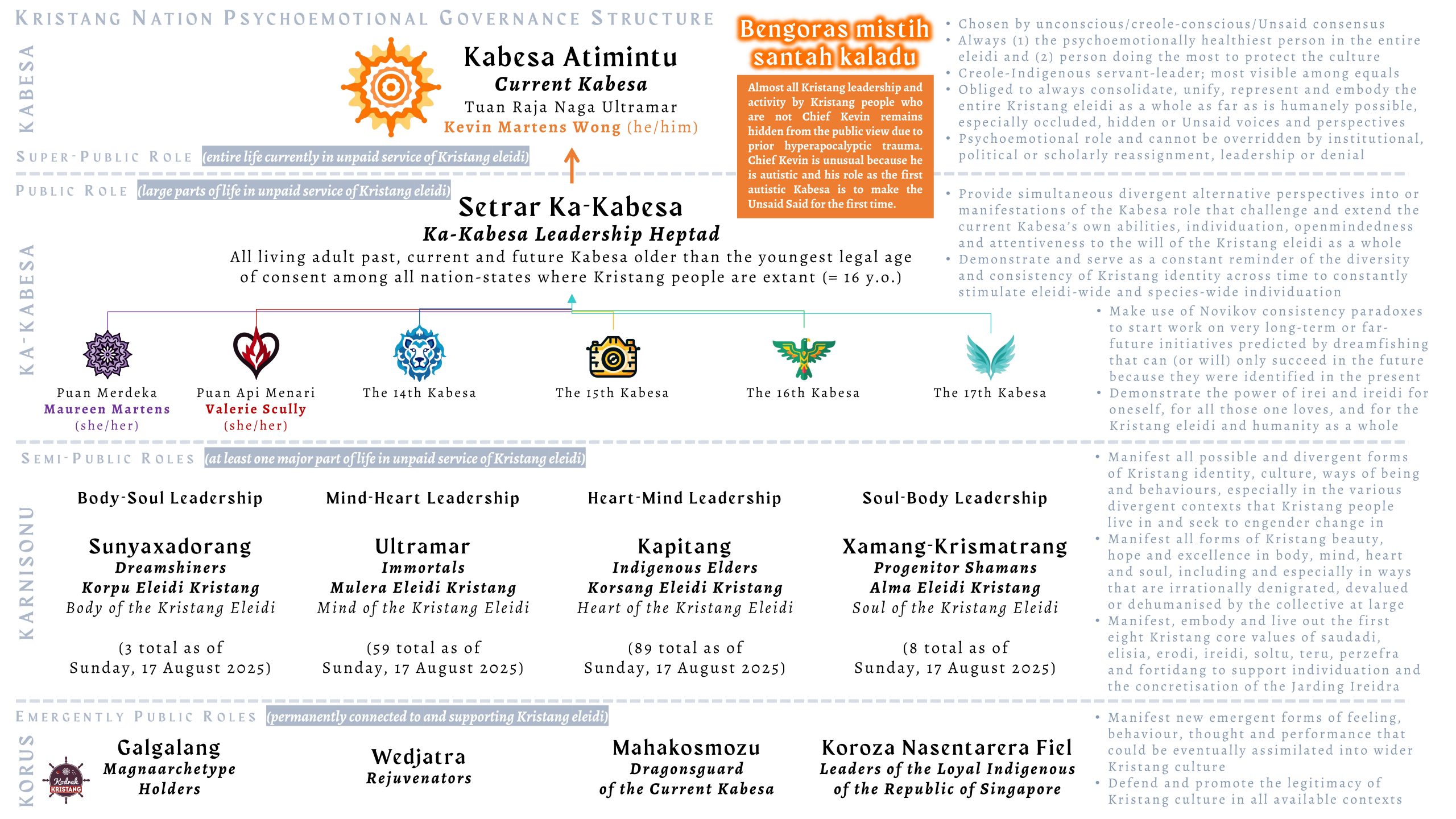
This governance ecology is distinct from institutionally visible and appointed or state-recognised roles such as the Rejidor of the Portuguese Settlement, and President of any Eurasian Association in Singapore and Malaya.