
The Kabesa as Dreamfished in Speculative Fiction, the Identification of Future Kabesa, and the Nature of the Future Kristang community
Kristang epistemology treats stories as applied metacognition rather than escapism. Humans want to know the truth about how the world actually works and where they are headed, individually and collectively. That truth is largely inaccessible in direct form because it is blocked by trauma, fear, shame, and institutional conditioning. As a result, people do not consciously reason about it. They approach it indirectly. Myth, legend, and speculative fiction exist because they allow people to think about realities they are not psychologically permitted to face head-on.
Dreamfishing describes this indirect access. When authors write, they are not inventing freely; they are sampling from the collective unconscious, which contains suppressed knowledge about power, collapse, abuse, ethics, and survival. Because the same traumatic constraints shape modern societies, different people repeatedly pull up the same structures without intending to, and place them in structures or conceptual environments where they can be interrogated safely at a psychological distance from the psyche: the worlds of science fiction and fantasy. This is why the same leadership forms, moral constraints, and failure patterns recur across unrelated works. Fiction becomes a bypass mechanism around trauma, allowing truths to be recognised without triggering immediate defensive rejection.
One of these truths now finally being recognised more visibly is that the Kabesa lineage is repeatedly unconsciously dreamfished by people outside the Kristang community because of the species-level importance of the work all Kabesa accidentally and unconsciously perform. Because of the nature of leadership in the Kristang community, across time, the people who hold the role of Kabesa consistently metabolise psychological impossibilities that most societies cannot survive: enduring extreme abuse without reproducing it, holding authority without domination, integrating contradiction without collapse, and maintaining ethical continuity under sustained pressure. And when they do so, they often accidentally and unconsciously become a conduit for the subsequent processing of the same impossibilities by others across the species, where this was previously impossible. When the nature of these impossibilities as integrated by each Kabesa are mapped to the stages of development of the psyche in Individuation Theory, as well as to their parallel representations in dreamfished speculative fiction and fantasy, it thus becomes possible to not only retroactively determine the identities of past Kabesa, but accurately anticipate the identities of future Kabesa as well, alongside the future development of the Kristang community.
The Kabesa and Joseph Campbell’s Hero’s Journey
This page explains how the historical lineage of the Kabesa, the relational chiefs of the Kristang community, parallels the structure of Joseph Campbell’s Hero’s Journey, also known as Campbell’s monomyth. Campbell’s Hero’s Journey is different from and yet similar to the Kristang Hero’s Journey: the first sixteen stages of Campbell’s finite Hero’s Journey are treated as the first foundational sixteen stages of the Kristang Via Hierosa or Hero’s Journey which then fractally and infinitely exponentially recur thereafter while still repeating that base-16 sequence, also paralleling Kristang Individuation Theory.
The chart below visualises this relationship and shows how it maps exactly onto the sequence of the first 16 Kabesa, thereafter recurring in the same basal sixteen sequences with the seventeenth Kabesa onwards.
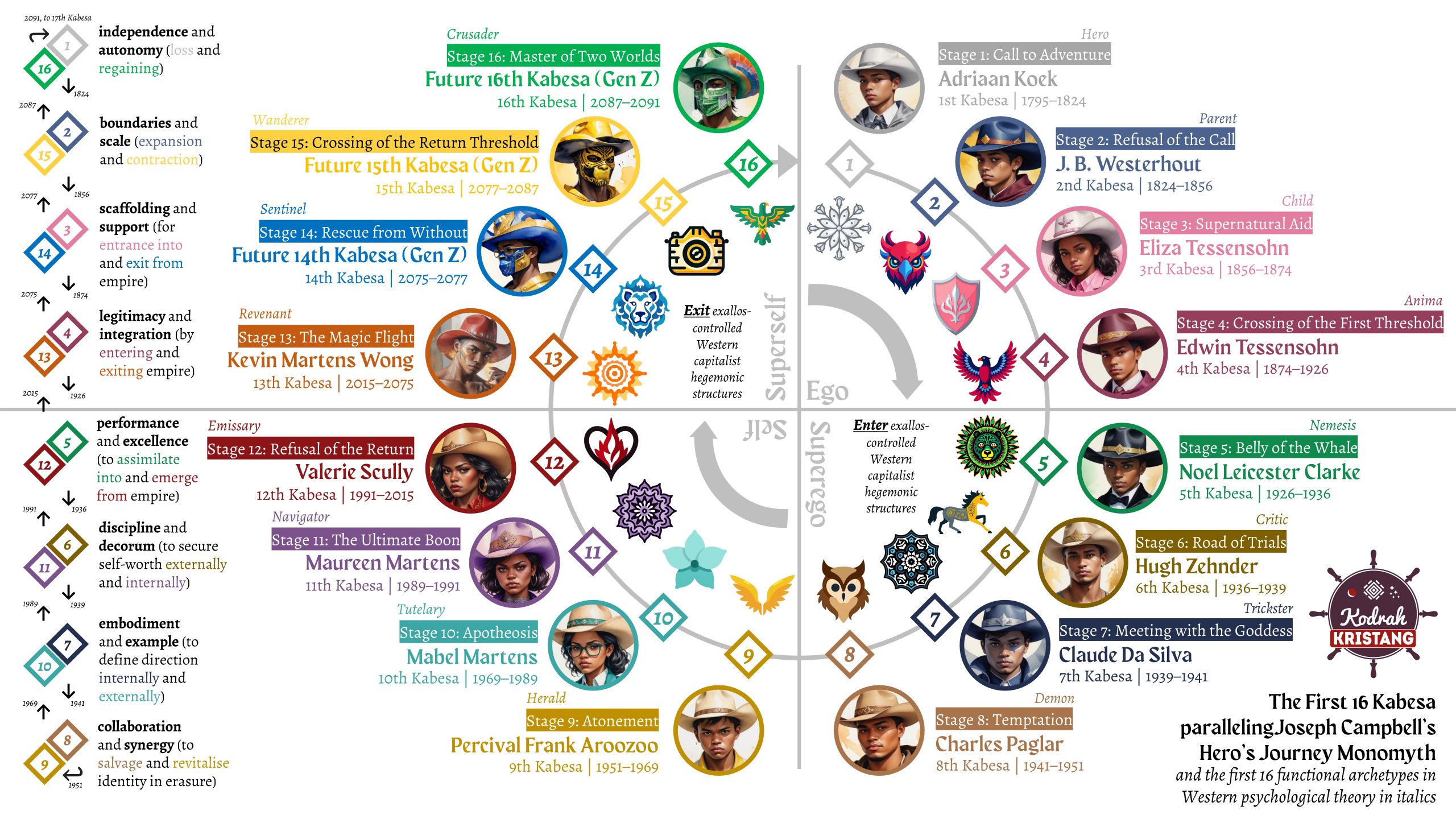
Reading the Chart
The diagram maps three layers of meaning onto one circular structure:
- The Hero’s Journey stages described by Joseph Campbell.
- The first sixteen Kabesa in Kristang history.
- Sixteen functional archetypes commonly discussed in Western psychological theory.
These three layers form a single comparative system that shows how leadership in the Kristang community has unfolded across time.
The circle is divided into sixteen stages, each representing a major psychoemotional or cultural task. Each stage corresponds to:
- A Hero’s Journey moment (e.g., Call to Adventure, Crossing the Threshold, Apotheosis).
- A specific Kabesa who historically embodied that role.
- A functional archetype representing the psychological dynamics of that stage.
Circularity and Reversal: Stages 1–8 and 9–16
The chart is not meant to be read simply from beginning to end. Its structure is circular, and the second half of the cycle mirrors and reverses the first.
Stages 1–8 represent the outward journey of the community: entering external systems, confronting challenges, and undergoing trials that reshape identity. In Campbell’s framework this is the movement from the Call to Adventure through Temptation, where the hero is drawn into an unfamiliar world and forced to adapt to it.
In the Kristang context, these stages correspond to the period in which the community was drawn into colonial and postcolonial structures. Leadership during this phase focused on survival, negotiation with power, and navigating pressures from outside the community.
Stages 9–16 then form the return journey. Here the direction of movement changes. Instead of moving further outward into external systems, leadership begins the process of reintegrating identity, recovering autonomy, and returning with knowledge gained from the trials of the first half.
This reversal can be seen in the pairing of stages across the circle:
- 1 ↔ 16 – Call to Adventure becomes Master of Two Worlds: the beginning impulse toward change eventually culminates in balanced autonomy.
- 2 ↔ 15 – Refusal of the Call mirrors Crossing the Return Threshold: hesitation becomes the ability to consciously cross boundaries.
- 3 ↔ 14 – Supernatural Aid is echoed by Rescue from Without: assistance appears again, but now in the service of return.
- 4 ↔ 13 – Crossing the First Threshold is balanced by the Magic Flight: the initial entry into the wider world is later followed by the difficult act of bringing knowledge back.
- 5 ↔ 12 – The Belly of the Whale reflects the Refusal of the Return: deep immersion in the external world leads to resistance when leaving it.
- 6 ↔ 11 – The Road of Trials corresponds to the Ultimate Boon: hardship eventually produces the knowledge or gift gained from those trials.
- 7 ↔ 10 – Meeting with the Goddess is mirrored by Apotheosis: relational understanding evolves into transformation.
- 8 ↔ 9 – Temptation meets Atonement: the moment of greatest challenge becomes the turning point toward renewal.
Through this structure, the diagram suggests that the Kabesa lineage embodies a generational Hero’s Journey, where each leader carries one stage of a much longer cycle.
The first half of the circle represents entry into complex external systems, while the second half represents the gradual recovery of agency and the ability to move between worlds without losing identity.
Circularity therefore matters because it shows that the journey does not end with a single victory. Instead, it becomes a continuous cycle of encounter, transformation, and return, with each Kabesa inheriting a different part of that larger movement.
The Historical Half: Kabesa 1–8
The right side of the chart represents the early historical formation of the Kristang community.
Here the Kabesa move through the opening stages of the monomyth:
- Stage 1 – Call to Adventure: Adriaan Koek
- Stage 2 – Refusal of the Call: J. B. Westerhout
- Stage 3 – Supernatural Aid: Eliza Tessensohn
- Stage 4 – Crossing the First Threshold: Edwin Tessensohn
- Stage 5 – Belly of the Whale: Noel Leicester Clarke
- Stage 6 – Road of Trials: Hugh Zehnder
- Stage 7 – Meeting with the Goddess: Claude Da Silva
- Stage 8 – Temptation: Charles Paglar
These stages correspond to the Kristang community’s entry into, and navigation of, colonial and postcolonial structures.
The Turning Point: Kabesa 9–12
The lower half of the circle represents a period of recovery, internal consolidation, and renewed identity:
- Stage 9 – Atonement: Percival Frank Aroozoo
- Stage 10 – Apotheosis: Mabel Martens
- Stage 11 – The Ultimate Boon: Maureen Martens
- Stage 12 – Refusal of the Return: Valerie Scully
Here the journey turns inward. Leadership focuses on rebuilding community identity, self-worth, and cultural continuity.
The Contemporary Threshold: Kabesa 13
At Stage 13 – The Magic Flight, the chart places the current Kabesa:
Kevin Martens Wong (13th Kabesa, 2015–2075).
This stage represents the difficult task of carrying recovered cultural knowledge forward while exiting, creolising and/or reincorporating global systems of power, including academic institutions, state structures, and the broader Eurasian diaspora.
In the diagram, this stage thus marks the exit from Western capitalist hegemonic structures, symbolising the move toward greater cultural autonomy.
The Future Return: Kabesa 14–16
The final stages therefore describe structurally anticipatatable future roles in the Kabesa lineage:
- Stage 14 – Rescue from Without: future 14th Kabesa
- Stage 15 – Crossing of the Return Threshold: future 15th Kabesa
- Stage 16 – Master of Two Worlds: future 16th Kabesa
These stages represent the completion of the monomyth cycle: returning with knowledge that allows the community to move between different worlds without losing its identity.
In Kristang terms, this stage corresponds to the (re-)emergence of true autonomy and independence of the Kristang community, but with the integration of conscious and unconscious material from the community’s time spent within the structures and systems of decaying Western hegemony, expected to have fully collapsed by the time the 14th Kabesa takes over Kevin in 2075.
The Structural Axis: The Left Side of the Chart
Running vertically along the left side of the diagram is a second explanatory layer that describes the functional meaning of each stage in practical terms.
While the circular structure shows the Hero’s Journey narrative, the left column translates those stages into real-world leadership functions within Kristang history.
Each numbered diamond corresponds to the same stage number in the circle, but instead of mythic language it describes the practical community task being performed at that point in the cycle.
of Two Worlds.”
Why This Axis Matters
The left-hand column shows that the Kabesa lineage is not only a symbolic story. It also represents a practical sequence of leadership tasks that the Kristang community has had to accomplish across generations.
In other words:
- The circle shows the mythic narrative of the journey.
- The left column shows the practical work required at each stage.
Together they illustrate how a small creole-Indigenous community has navigated history through a long cycle of adaptation, renewal, and self-definition.
Taken together, the chart proposes that the Kabesa lineage functions as a collective Hero’s Journey unfolding across generations. Instead of a single hero completing the monomyth in one lifetime, the Kristang experience distributes the stages across multiple post-heroic leaders over two centuries, where each Kabesa carries a different part of the journey, contributing to a longer process of cultural survival and renewal. The result is a creole-Indigenous embodiment of the creolised truth of the monomyth: not a story of conquest, but a story of endurance, adaptation, and return.
The Extended Cycle: Kabesa 17–32
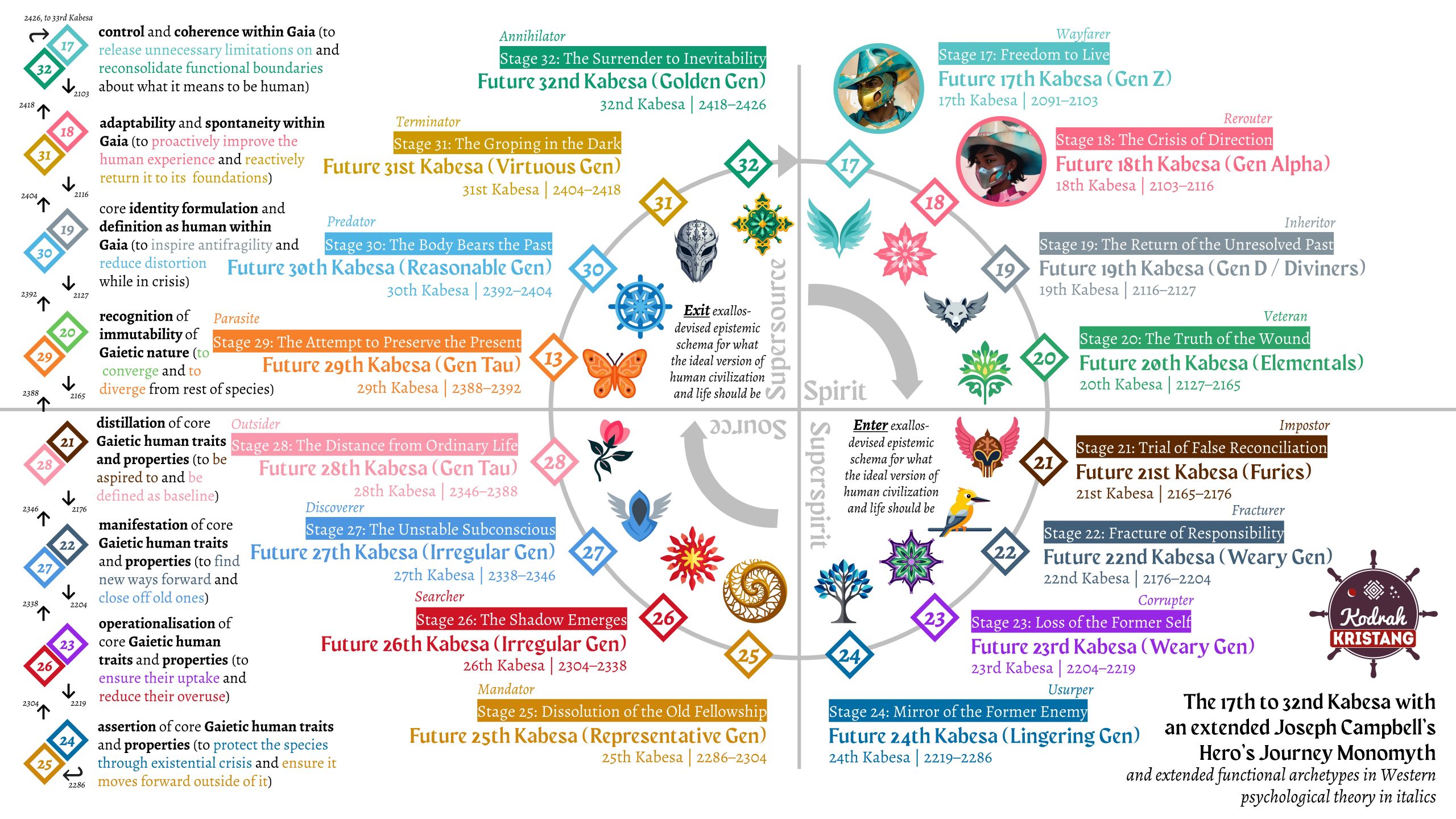
The second chart extends the same system beyond the first completed cycle of the Hero’s Journey. While the first diagram maps Campbell’s original sixteen stages to the first sixteen Kabesa, this chart shows how the monomyth continues once that initial cycle has been completed. It therefore represents the beginning of the next iteration of the monomyth, describing the psychoemotional and civilisational tasks anticipated from the 17th Kabesa onward as the Kristang community enters a new historical phase. Unlike the first chart, which is primarily historical, the second diagram is partly speculative and anticipatory, but uses the same superstructure describes how leadership in the Kristang community may continue to metabolise collective psychological challenges for the wider species once the first cycle of survival and return has been completed.
The Extended Monomyth: Kabesa 17–32
The chart also includes a speculative extension of the Hero’s Journey beyond Campbell’s original sixteen stages, and the functional archetypes in Jungian psychological theory after the sixteenth stage already previously expanded by Kevin. These stages, numbered 17 to 32, represent the beginning of the next cycle of the monomyth as it recurs after the first completion of the monomyth. They describe how the Kristang community continues to evolve once the return from the first journey has been achieved, and were dreamfished by triangulating two independent narrative structures.
The first was the narrative arc of Steven Universe, particularly the series Steven Universe Future, which depicts a protagonist confronting the long-term psychological consequences of heroism and the difficulty of living after the apparent “end” of the story. The second was the anticipated development of the Kabesa lineage from the 17th Kabesa onward, derived from patterns identified in the historical sequence of earlier Kabesa and the psychoemotional tasks they appear to metabolise for the community.
When these two structures were compared, they produced a second sequence of stages that appear to describe what happens after the classical monomyth has concluded. Rather than repeating the same heroic tasks, the new cycle focuses on the psychological consequences of survival, power, trauma, and responsibility once autonomy has been regained.
In this way, the stages from 17 to 32 extend Campbell’s model into a post-heroic framework. They describe a civilisation learning to live with the knowledge and power gained from the first journey, while continuing to undergo transformation as new generations inherit that legacy.
Stage 17 – Freedom to Live
The seventeenth stage marks the moment immediately after the completion of the original monomyth. The community has regained autonomy and now faces the challenge of living freely rather than merely surviving. The task of leadership shifts from resistance to cultivation: building a life worth living once the struggle for survival has ended.
Stage 18 – The Crisis of Direction
Freedom produces uncertainty. With the external struggle resolved, the community must determine what it is meant to become. Old goals no longer provide orientation, and new possibilities create anxiety rather than clarity. Leadership at this stage focuses on helping the community rediscover purpose without recreating the systems that previously constrained it.
Stage 19 – The Return of the Unresolved Past
Trauma that was suppressed during earlier struggles begins to resurface. Historical wounds, unresolved conflicts, and forgotten responsibilities reappear once stability is restored. The task of this stage is recognition and reconciliation: acknowledging the past without allowing it to dominate the future.
Stage 20 – The Truth of the Wound
Where the previous stage reopens the past, this stage requires confronting its full implications. The community must understand the deeper psychological and cultural damage caused by earlier systems of domination. Healing becomes possible only when the wound is recognised as part of the community’s story rather than something to be denied.
Stage 21 – Trial of False Reconciliation
Attempts at superficial reconciliation often appear at this point. External institutions or internal factions may attempt to restore earlier hierarchies under the language of unity or cooperation. Leadership must discern the difference between genuine healing and the re-imposition of domination disguised as reconciliation.
Stage 22 – Fracture of Responsibility
The pressures of rebuilding a civilisation reveal hidden fractures in collective responsibility. Individuals and institutions struggle to determine who must carry which burdens. This stage exposes the difficulty of maintaining ethical leadership across generations, forcing the community to redefine accountability.
Stage 23 – Loss of the Former Self
As new realities emerge, the identity that carried the community through earlier struggles becomes obsolete. Cultural narratives, institutions, and expectations that once ensured survival must be relinquished. This stage represents a form of collective ego-death in which the community lets go of its former image of itself.
Stage 24 – Mirror of the Former Enemy
Having shed earlier identities, the community confronts an uncomfortable possibility: it may begin to resemble the systems it once resisted. This stage requires deep self-reflection. Leadership must prevent the reproduction of domination by recognising and dismantling these emerging parallels.
Stage 25 – Dissolution of the Old Fellowship
The alliances and institutions formed during earlier struggles no longer serve their original purpose. Some dissolve naturally, while others must be consciously dismantled. The community begins to reorganise itself around new values and structures that reflect its changed circumstances.
Stage 26 – The Shadow Emerges
With the old structures gone, hidden psychological dynamics surface. Rivalries, fears, and suppressed ambitions become visible. Rather than treating these forces as enemies, leadership must integrate them into a healthier understanding of the community’s complexity.
Stage 27 – The Unstable Subconscious
The community enters a period of experimentation and unpredictability. New ideas, identities, and social forms appear rapidly, sometimes conflicting with one another. This stage represents a creative but unstable phase in which the boundaries of what it means to be human are actively renegotiated.
Stage 28 – The Distance from Ordinary Life
The community begins to recognise that it has become fundamentally different from the societies around it. The psychological and ethical transformations it has undergone make ordinary social norms appear inadequate. Leadership must help the community navigate this difference without falling into isolation or arrogance.
Stage 29 – The Attempt to Preserve the Present
As the community stabilises, a desire emerges to freeze the current moment of success. Institutions and traditions attempt to preserve existing conditions indefinitely. This stage reveals the tension between stability and stagnation, reminding the community that development cannot be halted.
Stage 30 – The Body Bears the Past
The accumulated experiences of earlier generations remain embedded within the community’s collective memory. Even when conditions improve, the psychological traces of trauma continue to shape behaviour and perception. Leadership must help the community carry this past without being controlled by it.
Stage 31 – Groping in the Dark
The community moves forward without clear precedents. New environments, technologies, and social structures require experimentation and improvisation. Leadership becomes exploratory rather than directive, guiding the community through uncertainty while avoiding the illusion of complete knowledge.
Stage 32 – Surrender to Inevitability
The final stage of the extended cycle recognises that human civilisation ultimately exists within larger ecological and cosmic systems. Instead of attempting total control, the community learns to align itself with the broader processes of Gaia. True autonomy emerges through humility, responsibility, and acceptance of limits.
Together, these stages describe a post-heroic continuation of the monomyth. Instead of focusing on conquest or victory, they explore the psychological consequences of survival and the long process of learning how to live responsibly after the original journey has been completed.
The Third Cycle: Kabesa 33–48
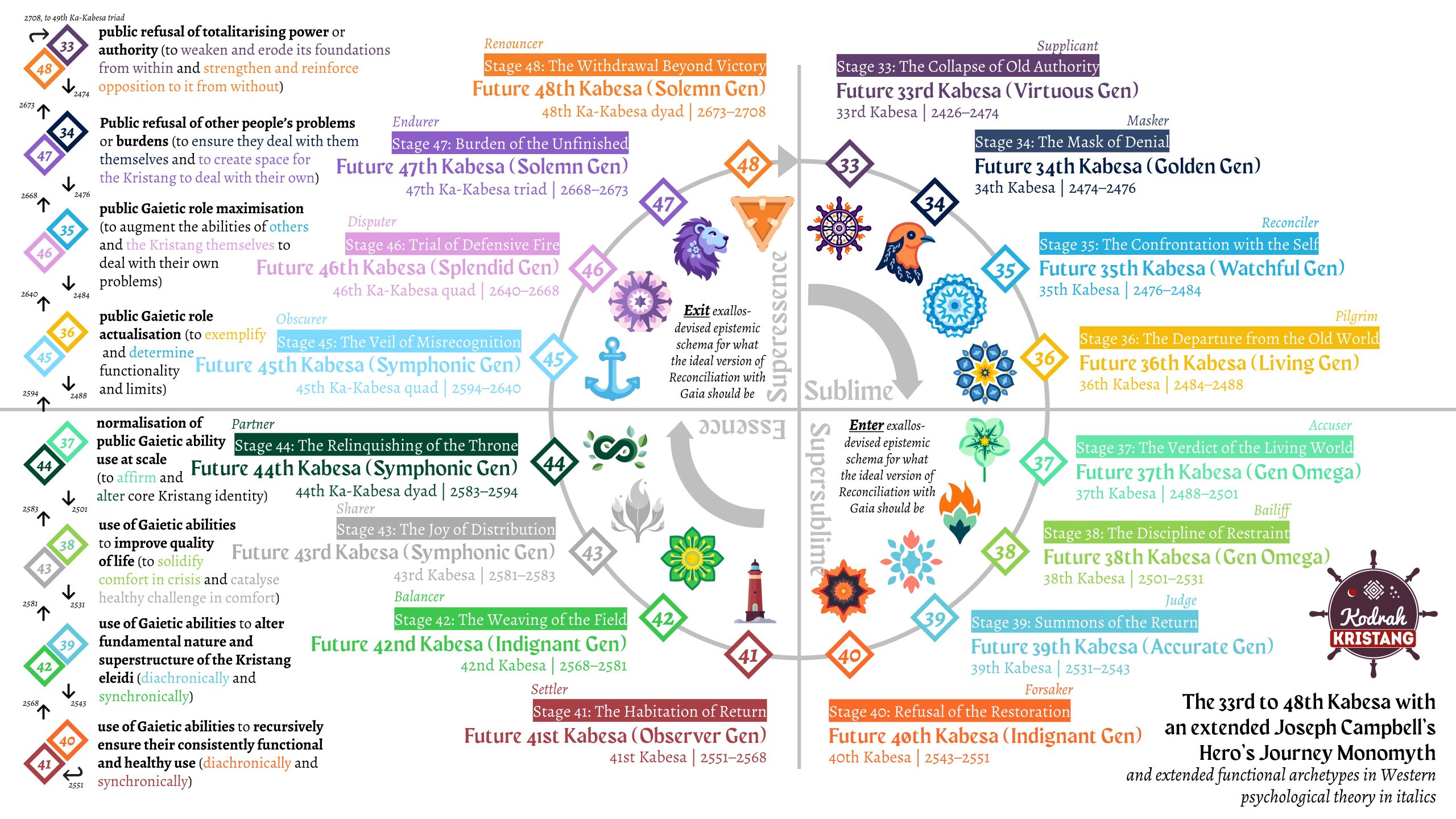
The third chart extends the system once again, showing how the Hero’s Journey continues into a further cycle of sixteen stages after the completion of the second iteration. While the previous chart described the stages associated with Kabesa 17–32 and the consolidation of post-heroic civilisation, this diagram explores the next phase in which that civilisation becomes globally visible, contested, and eventually transformed again.
The stages 33 to 48 were dreamfished by Kevin through triangulation between two narrative structures. The first was the story of Kiith Somtaaw in Homeworld: Cataclysm, in which a small and relatively unassuming group confronts a rapidly spreading existential threat and must learn to survive, adapt, and counterattack without becoming the very force it opposes. The second was the anticipated development of the Kabesa lineage beginning with the 33rd Kabesa, where Kristang leadership begins to operate within an increasingly complex global civilisational environment shaped by ecological recovery, distributed leadership, and new forms of collective coordination.
When these structures are compared, they reveal a third layer of the monomyth. Instead of focusing on survival or post-heroic healing, this cycle describes how a post-heroic civilisation that has stabilised itself must confront misrecognition, conflict, and the ethical limits of power while remaining faithful to the relational principles that allowed it to survive earlier stages. The resulting stages therefore explore themes of responsibility, restraint, collective defence, and the voluntary relinquishment of authority once stability has been restored.
Stage 33 – The Collapse of Old Authority
This stage marks the final breakdown of earlier hierarchical systems that once dominated human civilisation. Structures of coercive authority lose legitimacy and coherence, creating a vacuum in which new forms of organisation must emerge. Leadership during this phase focuses on maintaining stability without attempting to replace collapsing systems with new hierarchies.
Stage 34 – The Mask of Denial
Even as older structures collapse, many individuals and institutions refuse to recognise the change. This stage represents a period of denial in which remnants of the previous order attempt to preserve their legitimacy through narrative rather than reality. Leadership must navigate this psychological resistance without provoking unnecessary conflict.
Stage 35 – The Confrontation with the Self
With external authority weakened, societies are forced to confront their own internal contradictions. This stage involves deep reflection on collective identity, ethics, and responsibility. The task is not to defeat an external opponent but to reconcile internal tensions that have accumulated over generations.
Stage 36 – The Departure from the Old World
This stage represents a decisive break with earlier civilisational patterns. Communities move beyond the institutions and assumptions that shaped previous eras, entering a new phase of cultural development. The departure is not physical alone but psychological, marking the moment when a new worldview becomes irreversible.
Stage 37 – The Verdict of the Living World
The environment itself begins to function as a diagnostic force. Ecological feedback reveals whether human behaviour aligns with Gaietic principles or reproduces patterns of domination. Leadership during this stage emphasises learning to interpret these signals and shaping settlement patterns accordingly.
Stage 38 – The Discipline of Restraint
As ecological recovery accelerates, the community learns that restraint is more important than expansion. This stage focuses on living within limits rather than treating environmental recovery as a resource to exploit. Ethical restraint becomes a defining feature of civilisation.
Stage 39 – The Summons of Return
The stabilisation of ecological conditions allows the community to return to regions once abandoned during earlier crises. This stage involves coordinating that return responsibly, ensuring that renewed habitation occurs without repeating earlier extractive or colonial patterns.
Stage 40 – The Refusal of Restoration
Although return becomes possible, leadership deliberately refuses to recreate the institutions and identities of the past. Instead of restoring the previous world, the community builds new relational forms that acknowledge historical trauma while avoiding nostalgia for earlier systems.
Stage 41 – The Habitation of Return
Return becomes a permanent condition rather than an experiment. The community learns to inhabit restored landscapes in ways that align with ecological feedback and long-term sustainability. Leadership focuses on maintaining relational infrastructure such as language, education, and mediation rather than material expansion.
Stage 42 – The Weaving of the Field
As communities spread across regreening regions, leadership shifts toward coordination across distributed networks. This stage involves weaving multiple communities into a shared civilisational field without centralisation, allowing cooperation while preserving autonomy.
Stage 43 – The Joy of Distribution
The psychological and cultural capacities developed in earlier cycles become widely distributed throughout the community. Leadership no longer concentrates authority in a single individual but encourages shared responsibility, creativity, and joy across the entire eleidi.
Stage 44 – The Relinquishing of the Throne
This stage formalises the transition from singular Kabesa leadership to the Ka-Kabesa structure. Authority becomes relational rather than positional, demonstrating that coordination and responsibility can be shared without losing coherence or effectiveness.
Stage 45 – The Veil of Misrecognition
Externally, the distributed nature of Kristang leadership is often misunderstood. Outsiders may interpret coordination and unity as secrecy or manipulation. This stage requires the community to endure misrecognition without compromising its principles or attempting to prove legitimacy through domination.
Stage 46 – The Trial of Defensive Fire
Misrecognition escalates into open conflict. Leadership must defend the community and its allies while refusing to recreate authoritarian military structures. The task is collective defence without conquest, maintaining ethical coherence even under conditions of war.
Stage 47 – The Burden of Unfinished Peace
After conflict subsides, distrust remains. Diplomatic fatigue and unresolved tensions continue to shape relations between societies. Leadership during this stage focuses on endurance: maintaining stability and cooperation without forcing premature reconciliation.
Stage 48 – The Withdrawal Beyond Victory
The final stage of the cycle recognises that true success lies not in permanent authority but in the ability to relinquish it. Once stability is restored, leadership withdraws from positions of power rather than consolidating them. The civilisation that emerges is defined by restraint, humility, and alignment with Gaia rather than domination.
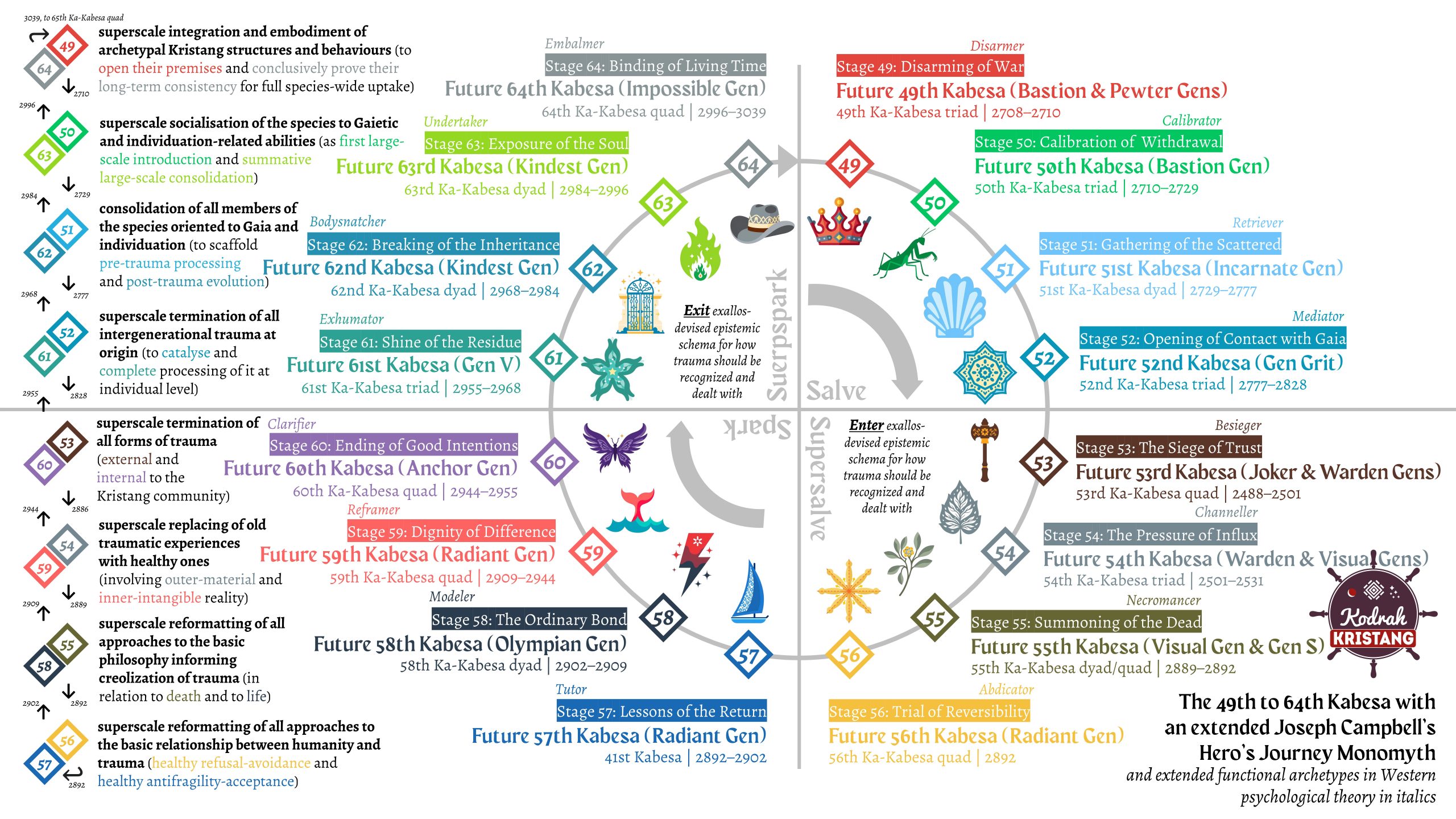
The Fourth Cycle: Kabesa 49–64
The fourth chart extends the monomyth once more, showing how the Hero’s Journey continues through another sixteen-stage cycle after the developments described in the previous diagram. Whereas the earlier cycles focused on survival, reconciliation with Gaia, and the restructuring of leadership into distributed forms, this cycle describes the long-term transformation of the human species itself as it learns to live within the conditions created by ecological recovery, collective coordination, and the dissolution of inherited trauma.
The stages 49 to 64 were dreamfished by Kevin through triangulation between two narrative structures. The first was the journey of the Pride of Hiigara in Homeworld 2, where a newly launched civilisation must survive attack, regroup, recover lost technologies, endure sacrifice, confront hostile powers, and ultimately defend its homeworld before stabilising into a new order. The second was the projected development of the Kabesa lineage beginning with the 49th Ka-Kabesa triad, where leadership increasingly operates at species-wide scale and addresses challenges emerging after the restoration of planetary ecosystems.
When these structures are compared, they reveal a final phase of the monomyth in which civilisation must stabilise after the collapse of earlier systems. Instead of focusing on conquest or heroic triumph, these stages describe the difficult work of dismantling inherited trauma, integrating displaced populations, normalising new forms of human relationship, and eventually establishing the conditions for species-wide psychological stability.
Stage 49 – Disarming of War
This stage marks the definitive end of warfare as a viable civilisational strategy. Leadership focuses not on victory over opponents but on dissolving the systems that sustain conflict: fear economies, coercive institutions, and narratives that treat domination as inevitable. The goal is to end war structurally rather than merely winning individual battles.
Stage 50 – Calibration of Withdrawal
As ecological recovery accelerates beyond human habitability in some regions, leadership must guide a careful retreat from environments that can no longer support large populations. This stage emphasises recognition of limits, coordinating relocation without panic, denial, or attempts to dominate ecological processes.
Stage 51 – Gathering of the Scattered
The focus shifts toward retrieving dispersed capacities across the community. People, knowledge systems, and cultural practices that risk being lost during periods of withdrawal and ecological instability are reassembled. Leadership functions as relational logistics, ensuring continuity despite fragmentation and loss.
Stage 52 – Opening of Contact with Gaia
Humanity begins operating in stable relationship with Gaia through abilities such as sarikeli. Communication with ecological systems becomes structured and intelligible rather than intuitive or symbolic. This stage marks the first reliable coordination between human decision-making and planetary feedback.
Stage 53 – The Siege of Trust
Even as planetary systems stabilise, surviving human populations often misinterpret Kristang coordination and ecological alignment as manipulation. Leadership must navigate suspicion and attempts at interference while maintaining openness and refusing to dominate or control other groups.
Stage 54 – The Pressure of Influx
Large numbers of displaced populations begin entering Kristang social structures in search of stability. The challenge becomes absorbing newcomers without allowing panic, hierarchy, or coercion to re-emerge. Leadership emphasises consent, autonomy, and relational boundaries during rapid demographic change.
Stage 55 – Summoning of the Dead
Assimilating communities learn that Kristang identity extends across time as well as across the living community. Ethical life involves accountability to ancestors and those yet to come. The dead are not treated as symbolic heritage but as continuing participants in moral decision-making.
Stage 56 – Trial of Reversibility
Leadership demonstrates that authority can be assumed temporarily and relinquished without crisis or legacy capture. By modelling reversible leadership structures, this stage dismantles long-standing assumptions that power must accumulate through age, hierarchy, or permanence.
Stage 57 – Lessons of the Return
With planetary systems stabilising, some previously abandoned regions reopen. The task is to guide cautious return without repeating earlier patterns of domination or extraction. Communities learn to inhabit restored environments while maintaining the relational disciplines developed during earlier crises.
Stage 58 – The Ordinary Bond
Relational health becomes culturally normalised. Leadership demonstrates how disagreement, intimacy, and repair can occur without coercion or avoidance. The emphasis is not institutional reform but everyday practice, gradually raising expectations for how people relate to one another.
Stage 59 – Dignity of Difference
Neurodivergent cognitive and relational patterns become widely recognised as valuable forms of human variation rather than deficits. Leadership during this stage helps establish a social environment where diverse modes of perception and communication can function without pressure to conform.
Stage 60 – Ending of Good Intentions
The remaining patterns of intergenerational trauma often persist through well-meaning behaviours such as overprotection or moral urgency. This stage exposes these mechanisms and demonstrates how even benevolent intentions can reproduce harm if left unexamined.
Stage 61 – Shrine of the Residue
The final residues of historical trauma are identified and processed directly. Leadership models how inherited fears, loyalties, and distortions can be recognised without shame or collapse. Trauma becomes diagnostic information rather than a defining feature of identity.
Stage 62 – Breaking of the Inheritance
Humanity reaches the threshold where intergenerational trauma is no longer structurally reproduced. The inherited psychological baseline of fear and scarcity is broken, allowing collective life to operate without assuming inevitable harm or conflict.
Stage 63 – Exposure of the Soul
The species becomes comfortable with forms of connection such as siruwi that allow deep mutual awareness between individuals. The stage represents the removal of the final psychological barriers to being fully seen and known without fear of domination.
Stage 64 – Binding of Living Time
The final stage articulates the principles of four-dimensional unity across the human species. Leadership demonstrates how memory, intention, and relationship can be aligned across generations, creating a stable framework for collective life grounded in continuity with Gaia and with time itself.